Business License
Blog Categories
Coal Mine Hydraulic Support Protection Mesh Installation Between Supports
A support net installation looks like hanging a panel on two hooks, and that impression is the reason most of them are done wrong the first time.
The panel has to end up with a measured amount of slack, at a measured height, on fixings that can rotate, and none of those three can be judged by eye on a face that is being advanced at the same time.
This article covers the sequence of between support mounting, the three fixing points that carry the load, the free length that decides how long a panel lasts, the hanging height that keeps the walkway clear, the safety order when work happens under a supported roof, and the faults that appear within the first month when the sequence is wrong.
1. What Support Net Installation Involves Underground
A support net installation is not a bolt-on operation. It is a set of measurements taken against two moving steel structures, transferred to a panel, and repeated on every support along a face that may be two hundred metres long.
The measurement that matters is not the gap between two canopies at the moment of hanging. It is the range that gap passes through during a full advance cycle, because the panel has to work across the whole range rather than at one point in it.
That range is set by the web, by the lowering stroke, and by how far out of step the two neighbouring supports run. In practice it is between six hundred and a thousand millimetres in the direction of advance and a hundred to a hundred and fifty millimetres vertically.
Everything in the installation follows from those two figures, which is why a support net installation that begins with a panel rather than with a measurement will be corrected on the face instead of on a drawing.
2. Where Between Support Mounting Fits in the Cycle
Between support mounting has one correct window in the cycle, and it is after the support has been set against the roof and before the next support is lowered.
Hanging while a support is still being pushed forward means the panel is being fixed to two points whose distance is changing under the fitter's hands. The free length measured in that condition is a figure that will never occur again.
The order along the face is therefore: set the support, hang the panel to it and to its already-set neighbour, check the figure, then move to the next support as it is set. Working with the advance rather than against it keeps every measurement taken against two fixed points.
This also fixes the direction of work. Between support mounting runs with the face, from the set end towards the moving end, so that each panel is hung to one support that has already been set and one that has just been set.
3. The Three Fixing Points and Mining Mesh Fixing Practice
Mining mesh fixing on a face panel is normally a three-point arrangement: a hook at each canopy edge and a tie at the bottom edge to keep the panel from swinging into the walkway.
The two top hooks carry the load. The bottom tie carries almost nothing vertical, and it exists to control the shape of the panel rather than to hold it up. Treating it as a load-bearing point is a common error and it puts a bending moment into the bottom wire that the ferrule cannot take.
| Fixing point | Carries | Fault if wrong |
|---|---|---|
| Hook at canopy edge | Panel weight and cyclic load | Wire breaks at the hook within a few webs |
| Second hook at the neighbour | Same, in the opposite sense | Panel rotates and rubs the canopy side plate |
| Bottom tie | Shape control alone | Panel bags into the walkway or lifts onto the conveyor |
Good mining mesh fixing keeps the hook able to rotate. A clamp that grips the rope and a hook that the rope can move in look similar in a photograph and behave differently over a thousand cycles, because the clamp concentrates all the movement at one point on the wire.
The hook also has to be reachable from the walkway side without the fitter leaning through the gap it is meant to protect. That is a detail worth settling on the drawing, because it decides whether a panel can be re-hung during a shift or has to wait for a maintenance window.
4. Free Length, Bracket Detail and Mining Mesh Fixing at the Hook
The free length is the distance between the last ferrule and the hook. It is the single figure that separates a panel that lasts a face from one that is re-hung every month, and it is rarely written on a mine's own drawing.
Too little free length puts the cyclic movement straight into the wire at the hook, and the wire fatigues where it is bent over the hook radius. Too much and the panel hangs into the walkway, catches the conveyor, or is walked on until it is cut away.
A hundred to a hundred and fifty millimetres beyond each hook suits most faces with a web in the six to ten hundred millimetre range. The figure scales with the web rather than with the panel, so a face that shortens its web at a disturbance should shorten the free length at the same time.
Hebei Longen Wire Mesh Products Co Ltd calculates the free length from the web width and the canopy geometry and states it on the drawing, rather than leaving the fitting team to judge on the face. Longen also supplies a short gauge with each order, because a free length judged by eye is the figure that varies most between shifts.
5. Hanging Height and Clearance After Between Support Mounting
Hanging height is measured to a datum, and the datum should be the conveyor deck rather than the floor, because the floor moves and the deck is what a person steps over.
A panel hung too low drags on the deck and wears through at the bottom wire within weeks. A panel hung too high leaves a gap at the bottom edge, which is exactly where small material arrives after rolling down the face.
The usual target is a bottom edge between a hundred and a hundred and fifty millimetres above the deck, which is high enough to clear normal spillage and low enough that a boot or a tool cannot pass under it.
On a face with variable floor, that allowance has to be taken at the lowest point of the section rather than at the survey station, or the panel will be correct in one place and dragging in another.
6. Working Under a Supported Roof During Support Net Installation
The installation sequence has a safety order as well as a mechanical one, and the two are not the same.
A fitter hanging a panel is working between two supports, which is the one place on a face where the roof is not directly carried. The panel is not a roof support and must never be used as one, even briefly, and no part of the installation should put a person under an unsupported span.
The work is therefore done from the walkway side, with the support set and the canopy edge within reach, and with the neighbouring support set as well. Where the gap is too wide to reach across, the panel is hung from one side and pulled into position rather than the fitter entering the gap.
Tools are the second hazard on this job. A spanner dropped during installation is a falling object in the space the panel is fitted to catch falling objects, so the fixing kit is tethered and the area below is cleared for the duration.
7. Mining Mesh Fixing Faults That Appear Within a Month
Four faults account for most of the call-outs on a newly hung face, and all four are visible within a month.
The first is wire breaks at the hook, which points to a free length that is too short or a clamp that will not let the rope rotate. The second is a panel that has rotated and is rubbing the canopy side plate, which points to a bottom tie that is too tight or missing.
The third is a bagged panel hanging into the walkway, which points to too much free length or a panel hung before its neighbour was set. The fourth is a torn bottom edge, which points to a hanging height taken from the floor rather than from the deck.
None of the four is a material fault, and all four are cheaper to correct by re-hanging to the drawing than by replacing the panel. Hebei Longen Wire Mesh Products asks for the position of any failure on the face as well as a photograph, because a break at the hook and a break in the middle of a panel have different causes.
8. Two Faces Where the Between Support Mounting Sequence Was Wrong
On a face with a nine hundred millimetre web, panels were hung immediately after each support was pushed forward rather than after it was set. The free length measured in that condition was two hundred millimetres, and every panel bagged into the walkway once the support was set. Re-hanging the same panels to a hundred and forty millimetres after setting cured it without a change of panel.
On a second face the bottom tie was clamped hard to the panel to stop it swinging. The tie held, and the bottom wire broke at the clamp within three weeks because the clamp had become the point where all the cyclic movement arrived. Replacing the clamp with a hook that allowed movement, and setting the tie slack, ended the failures.
Longen Wire Mesh Products supplies the hook and the bottom tie as a matched pair for that reason, and marks the rotation allowance on the drawing so that a fitter does not clamp a component that was designed to move.
9. Frequently Asked Questions
9.1 How long does support net installation take per support?
Between ten and twenty minutes per support for a two-person team once the sequence is established, which is fast enough to keep up with a face that advances several supports per shift. The first few take longer because the free length and the hanging height are being set against the drawing rather than repeated. A team that is taking much longer than that is usually working against the advance rather than with it, or is measuring each panel from scratch instead of from a gauge. The figure assumes the brackets are already on the canopy and the panels are at the face rather than in a store.
9.2 Can panels be hung before the face is fully developed?
They can be hung as the face advances, and that is the normal practice, but each panel needs both of its supports set before the free length is fixed. Hanging to a support that is still moving means the figure is measured in a condition that will not recur. Where a face is being developed ahead of production, the panels can be prepared and marked to the drawing and hung later, which is usually the better arrangement because the marking is done at a bench rather than at height.
9.3 What is the correct torque for a mining mesh fixing clamp?
There is no single figure, because the answer depends on whether the fixing is meant to grip or to allow movement. A clamp that grips the rope should be tight enough that the rope cannot be turned by hand, and a fixing that allows rotation should not be a clamp at all. The common error is to tighten a hook until it grips, which converts a rotating fixing into a clamped one and moves the fatigue point onto the wire. Follow the drawing, and where the drawing shows a hook, do not substitute a clamp.
9.4 Why does a panel rub against the canopy side plate?
Because the bottom tie is too tight, missing, or set on the wrong side, so the panel rotates about its two top hooks instead of hanging square. The rotation is small per cycle and cumulative over a shift, and the rub removes coating first and wire second. A panel found rubbing should be re-hung with the tie set slack rather than adjusted by shortening the tie. Where the geometry leaves no room for a tie, a stand-off bracket on the canopy edge is the alternative, and it has to be designed with the panel rather than added afterwards.
9.5 Does the hanging height change as the face advances?
It does, because the floor heaves behind the supports and the deck follows the conveyor rather than the floor. A panel that is correct at the start of a block can be dragging by the end of it. The practical answer is to check the bottom edge against the deck at each support as the face passes, and to re-hang any panel that has less than a hundred millimetres of clearance. Checking the height at the same time as the free length turns two inspections into one walk.
Recently Posted
-
Coal Mine Hydraulic Support Protection Mesh: Aperture and Strength
November 20, 2026Aperture and strength are usually quoted as two numbers on the same line, and on a working face they are two different arguments. Read More
-
Coal Mine Hydraulic Support Protection Mesh Material and Corrosion
November 20, 2026Mining mesh corrosion is not a slow background process on a working face. A panel can go from bright to stained in a single shift, Read More
-
Coal Mine Hydraulic Support Protection Mesh: Stretch and Lift Behaviour
November 19, 2026A support lifting net is asked to do something no ordinary barrier does: it has to change its shape every time the steel it hangs
Read More -
Coal Mine Hydraulic Support Protection Mesh and Working Face Safety
November 19, 2026Working face protection is a system rather than a product, and the mesh between the supports is one line of it. The other lines ar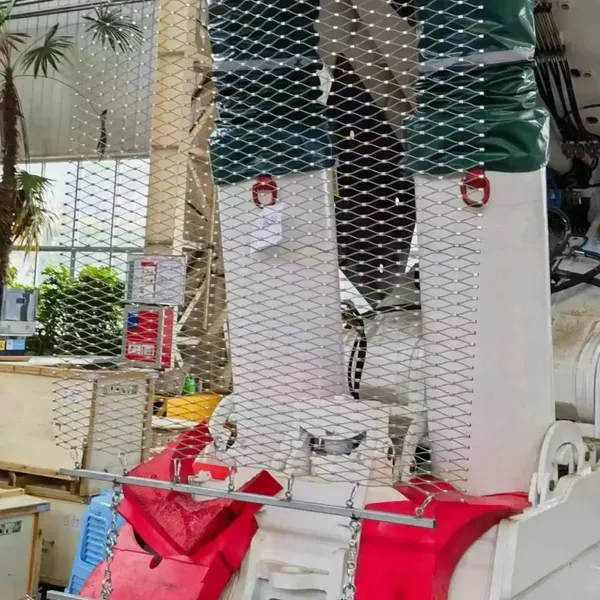 Read More

Contact Us

Recommended Products
-
 Slope Protection System Rockfall Netting 2.0mm 3.0mm 4.0mm High Tensile Steel Wire Mesh Netting Rockfall BarriersUS$ 2 - 15MOQ: 1 Square Meter
-
Flexible Debris Flow Barrier Steel Rope Rockfall Barrier With Ring Diameter 350 mm China SupplierUS$ 5.9 - 40MOQ: 1 Square Meter
-
Custom Hexsteel Mesh for Refractory Linings Stainless Steel Wire Plain Weave Welded Cutting Welding Offered Made ChinaUS$ 9.20 - 45.00MOQ: 50 Square Meters
-
Double Twist Hexagonal Mesh Rockfall Netting Drapery System for for Rockfall Mitigation Slope Consolidation WorksUS$ 0.45MOQ: 100 Square Meters
-
China Factory Galvanized Steel Railway Side Slope Stabilization Net Woven Wire Mesh for Slope Protection Include Bending WeldingUS$ 15.00 - 20.00MOQ: 999 Square Meters


-
Galvanized Gabion Baskets for Retaining Wall Plain Weave Cutting Processing Service for Slope Stabilization-Free Sample OfferedUS$ 1.5 - 1.7MOQ: 1 Square Meter
-
Children's Playground Stainless Steel Rope Mesh Balcony Fence Inox Cable Net Build Guardrail Black Oxide Rope NettingUS$ 2.8MOQ: 1 Square Meter
-
Factory Direct Modern High Transparency Anti-Slip Stainless Steel Rope Mesh Stair Railing Woven Cable Netting Custom ProjectsUS$ 9.9 - 14.9MOQ: 1 Square Meter
-
Stainless Steel Rope Mesh for Backpack and Bag Anti Falling Dropring Mesh Inox Cable Net Anti-theft Black Oxide Rope NettingUS$ 118.00MOQ: 100 Square Meters
-
Heavy-Duty 4ftx5ft Drag Mat Factory With Chain Galvanized Steel Drag Mat for Tractor AttachmentUS$ 9.1 - 45MOQ: 1 Square Meter


-
High Altitude Anti Fall Woven Stainless Steel Wire Rope Net SS 304 316 316L Plain Weave Invisible Protective NetUS$ 9.9 - 14.9MOQ: 1 Square Meter
-
China Rope Mesh Manufacturer Customized SS316 Black Oxided Ferrule Type Rope MeshUS$ 5 - 20MOQ: 1 Square Meter
-
Baseball Field Dragging Lawn LevelingUS$ 59.00 - 66.00MOQ: 5 Pieces
-
316L Grade Stainless Steel Wire Mesh Sieves 200mm 300mm Screen Factory Price Sand Testing ScreenUS$ 4.7 - 15MOQ: 1 Piece
-
Outdoor Stainless Steel Cable Railing / Wire Rope Mesh / Wire Mesh Railings for BalconyUS$ 15.00 - 20.00MOQ: 100 Square Meters


-
Slope Protection System 65/3, High-tensile Steel Wire Mesh, Spike Plate, Rock Nail, Connection Clips T3 for Slope StabilityUS$ 1.80 - 3.00MOQ: 1 Square Meter
-
Pool Mesh Steeltex Paper-Backed Welded Wire Mesh Factory Price 12ga 16gaUS$ 40 - 70MOQ: 30 Rolls
-
G65 3 Rockfall Netting Rust Free Coated Slope Protection Net Galvanized High Tensile Wire Mesh Control Shallow LandslideUS$ 5.40 - 5.60MOQ: 1 Meter
-
Anti‑Drone Protection Steel Rope Net UAV Security Protection Fence Mesh Galvanized /Stainless Steel Customized ProductionUS$ 1.1 - 1.2MOQ: 100 Square Meters
-
Anti-Drone Netting, Galvanized High Tensile Steel Wire Rope Mesh, UVA Protection Net, CE Factory Customized ProductionUS$ 1.00 - 2.00MOQ: 999 Square Meters