Business License
Blog Categories
Coal Mine Hydraulic Support Protection Mesh: Stretch and Lift Behaviour
A support lifting net is asked to do something no ordinary barrier does: it has to change its shape every time the steel it hangs from moves, and go back to roughly where it started.
That behaviour is the difference between a panel that lasts a face and one that is re-hung every month, and it has almost nothing to do with the strength of the wire.
This article explains what stretch actually means in a rope net, the three directions of movement in one support cycle, the free length that makes the geometry work, the work hardening that ends a panel's life, and the four ways a support lifting net fails.
1. Why a Support Lifting Net Must Move With the Canopy
A support lifting net hangs between two canopies, and those two canopies are never in the same position for long.
In a typical cycle a support is lowered by a hundred to a hundred and fifty millimetres, pushed forward by a web of six hundred to a thousand millimetres, then raised and set against the roof.
Each support does this on its own, in sequence along the face. At any moment one support is lowered while its neighbour is still set, so the distance between their canopy edges is changing in two directions at once.
A panel that resists that change will transfer it into whatever is holding it. In practice that means the hook, the bracket, the canopy edge or the wire next to the fixing.
So the requirement is not strength under a static load. It is the ability to accommodate several hundred millimetres of relative movement, repeatedly, without permanent deformation at the fixing.
2. Stretchable Mining Mesh: What Stretch Actually Means
Stretchable mining mesh does not stretch in the way a rubber sheet stretches, and understanding that is the key to specifying it.
The wire rope itself is elastic for less than one percent of its length. A three metre rope pulled to half its breaking load extends by a few millimetres, which is nothing against a web of eight hundred.
What actually accommodates the movement is the geometry. The mesh distorts: squares become parallelograms, diamonds lengthen in one direction and narrow in the other, and the panel as a whole changes shape without any wire being strained.
That distortion is worth twenty to forty percent of the panel dimension, which is why a rope net is used for the duty and a welded grid is not. A welded grid has rigid joints and cannot distort, so it tears at the weld instead.
| Panel type | Movement absorbed | Where it fails |
|---|---|---|
| Rope net, knotted | Geometry, 20 to 40 percent | At the hook |
| Rope net, ferrule | Geometry, less at each joint | At the ferrule |
| Welded grid | Almost none | At the weld |
The practical consequence is that a support lifting net should be specified by the movement it has to accommodate, not by the load it can hang. A panel chosen on breaking strength alone will be stiff, and stiffness is the property that ends a face panel early.
3. Net Movement With Support: Three Directions in One Cycle
Net movement with support happens in three directions and they do not arrive separately.
The vertical direction is the lift and the set. A hundred to a hundred and fifty millimetres of canopy travel changes the hanging height and slackens or tightens the panel.
The longitudinal direction is the advance, which is the largest movement by far. A web of six hundred to a thousand millimetres means two adjacent canopies can be that far out of step at the worst moment of the sequence.
The transverse direction is the tilt. A canopy that is set against an uneven roof is not parallel to its neighbour, so the gap is wider at the front than at the back and the panel is asked to twist.
A panel that handles the advance and ignores the twist will hang with one edge slack and the other tight, and it will tear on the tight side within a few webs. That is why the hanging detail allows rotation at the bracket rather than slack alone in the panel.
4. The Free Length That Makes Stretchable Mining Mesh Work
Free length is the amount of panel left hanging beyond each bracket, and it is the single figure that decides whether stretchable mining mesh survives a face.
The free length gives the panel something to give. Without it, the advance is taken directly as tension at the hook; with it, the advance is taken as a change of shape in the loose part.
The figure is set from the movement, not from a habit. A face with an eight hundred millimetre web needs more free length than one with six hundred, and a face with a wide canopy tilt needs more again.
Too much free length is also a fault. The panel then hangs into the walkway, catches the conveyor or is walked on, and it is cut away rather than adjusted.
Net movement with support is therefore a balance between two failures, and the figure that balances them is a calculated one rather than a matter of what looks right on the day of the installation.
Hebei Longen Wire Mesh Products Co Ltd calculates the free length from the web width and the canopy geometry and states it on the drawing, rather than leaving it to the fitting team to judge on the face. Longen also supplies a short gauge for each order, since a free length measured by eye is the figure that varies most between shifts.
5. Work Hardening in a Stretchable Mining Mesh
Every cycle strains the wire a little, and the strain accumulates in a way that is not visible from outside.
Cold drawn stainless wire work hardens. Each time it is bent past its elastic limit it becomes stronger and less ductile, and after enough cycles it cracks rather than bends.
On a face advanced several times a day, a panel can see well over a thousand cycles in a year. That is more than a building barrier sees in its life, and it is the reason a panel that looks sound can fail at a hook without warning.
The control is to keep the strain per cycle low, which means more free length and a geometry that distorts rather than a wire that bends. A larger aperture helps, because each wire has further to travel before it is asked to bend sharply.
The other control is the joint. A ferrule concentrates strain at its end, and a knot spreads it over a longer length, which is why knotted construction is often chosen for a face with a high cycle count.
6. Net Movement With Support at the Bracket
The bracket is where the movement is concentrated, and it is the part of the assembly that is designed rather than bought.
A clamp holds the panel rigidly and converts the advance into tension. A hook with a keeper lets the panel swing, so the movement becomes rotation rather than pull.
The hook also allows the panel to be lifted off for inspection or replacement without tools, which matters on a face where the work is done in a confined space at height.
The keeper is what stops the panel jumping off the hook during a lift. It should be a captive pin rather than an open hook, because an open hook plus a slack panel plus a lift is a panel on the floor.
Longen Wire Mesh Products supplies the hook and keeper as a matched pair, and marks the rotation allowance on the drawing so that the installer does not clamp the keeper down against the panel.
Hebei Longen Wire Mesh Products keeps the hook and the keeper in the same bag as the panel rather than in a separate fixing box, because a face that runs out of keepers will hang the panels anyway.
7. Support Lifting Net Failure Modes
A support lifting net fails in four ways, and three of them are at the edge rather than in the field of the panel.
The first is a broken wire at the hook, caused by tension rather than by impact. It appears as a single bright wire end and it is the earliest sign that the free length is wrong.
The second is ferrule slip, where the joint moves along the rope under cyclic load. It shows as an aperture that has grown in one part of the panel and it is not repairable underground.
The third is a torn eye, where the panel has been pulled off the hook by a lift with the keeper missing. It is a fitting error rather than a product fault, and it is the most common.
The fourth is permanent bagging, where the panel has been overloaded once and has not recovered. It still catches material, it hangs lower than its neighbours, and it is the panel that fouls the walkway next.
All four are visible on a walk of the face, and all four are cheaper to fix by replacing the panel than by repairing it in place. A repair underground disturbs the net movement with support around that bracket, and the panel usually returns to the workshop in a worse state than it left.
8. Two Faces Where the Free Length Decided the Life
A face with a seven hundred millimetre web had panels hung tight against the brackets, and the wires at the hooks were breaking within four to six webs. The free length was increased to a hundred and forty millimetres beyond each bracket and the hook was changed from a clamp to a hook with a captive pin. Wire breaks at the hook stopped for the remainder of the face, and the panels were still in service when the face finished.
A second face kept the same panels but reduced the web to five hundred and fifty millimetres at a geological disturbance. The free length was reduced to ninety millimetres at the same time, and the panels stopped swinging into the walkway without a change of panel type.
9. Frequently Asked Questions
9.1 How much movement can a support lifting net absorb?
Between twenty and forty percent of its own dimension, through geometric distortion rather than wire stretch. A panel two metres wide can therefore follow roughly four hundred to eight hundred millimetres of relative movement between its two fixings, which covers a normal web with margin. The figure is reduced by a ferrule at every joint and by a tight hanging detail. It is not increased by using a thicker rope, because a thicker rope distorts less for the same load and puts more strain into the bracket.
9.2 Why does the panel go slack after a lift?
Because the canopy it hangs from has moved down and forward while its neighbour has not, so the distance between the two fixings has shortened. The slack is the panel accommodating that movement, and it recovers as the supports come back into line. A panel that stays slack after the whole face has been advanced is a different matter, and it usually means the panel has been permanently deformed by an overload rather than by the cycle. That panel should be replaced rather than re-tensioned, because a bagged panel fouls the walkway on the next advance.
9.3 Does a stretchable mining mesh need a different aperture?
It benefits from a more open aperture than a stiff panel of the same duty, because each wire has further to travel before it is asked to bend sharply, and the strain per cycle is lower. The limit is the material that has to be caught, which is a roof condition question. On a face with a friable roof the two requirements meet at around forty to sixty millimetres, and that is where most face specifications settle after a trial.
9.4 What causes a ferrule to slip?
Cyclic load combined with a swage that was set at the low end of its tolerance. Each cycle moves the rope a fraction inside the ferrule, and the movement does not reverse, so the joint walks along the rope over hundreds of cycles. The result is an aperture that grows in one area of the panel while the rest stays as made, and the growth continues at a rate that depends on the load rather than on the calendar. It cannot be repaired underground, and a panel showing it should be replaced rather than re-tensioned.
9.5 Can the free length be adjusted on the face?
It should not be adjusted on the face at all, beyond re-hanging to the figure on the drawing. A knot changes the load path and concentrates strain at one point, and a cut length cannot be put back when the next web needs more slack. Where the figure does not suit the face, the correct action is to report it and to have the panels made to a new one, which is a drawing change rather than a site adjustment. That report is how the specification improves for the next face.
Recently Posted
-
Coal Mine Hydraulic Support Protection Mesh and Working Face Safety
November 19, 2026Working face protection is a system rather than a product, and the mesh between the supports is one line of it. The other lines ar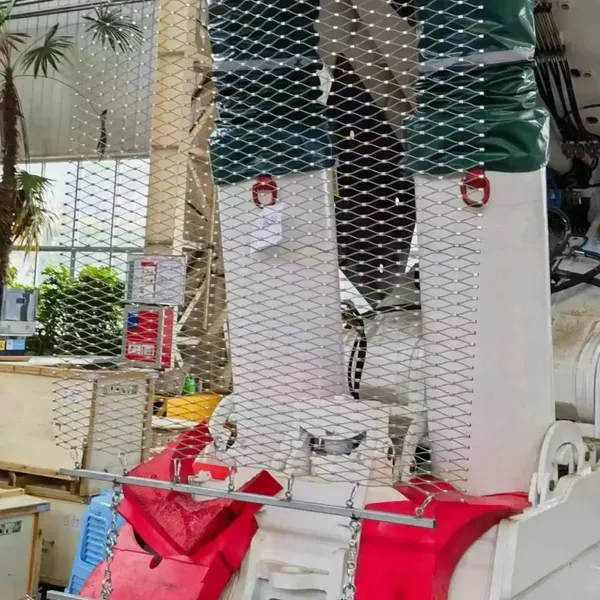 Read More
-
What Is Coal Mine Hydraulic Support Protection Mesh?
November 19, 2026A longwall face is a line of steel canopies holding up a roof that is trying to come down, and between every two canopies there is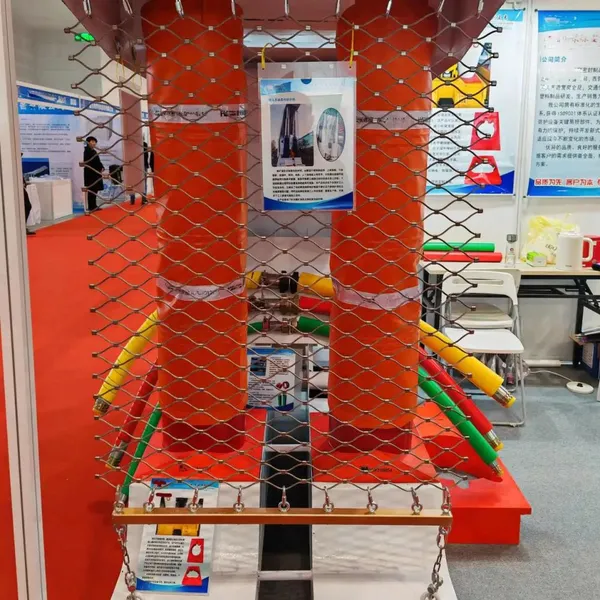 Read More
-
Specifying Black Oxide Stainless Steel Wire Rope Mesh: What to Send
November 18, 2026A dark net order fails for a small number of predictable reasons, and almost all of them are traceable to information that was not Read More
-
Cleaning and Handling Black Oxide Stainless Wire Rope Mesh
November 18, 2026Most of the damage done to a dark stainless net happens in two places, and neither of them is a defect in the panel. One is a buck Read More

Contact Us

Recommended Products
-
 Slope Protection System Rockfall Netting 2.0mm 3.0mm 4.0mm High Tensile Steel Wire Mesh Netting Rockfall BarriersUS$ 2 - 15MOQ: 1 Square Meter
-
Flexible Debris Flow Barrier Steel Rope Rockfall Barrier With Ring Diameter 350 mm China SupplierUS$ 5.9 - 40MOQ: 1 Square Meter
-
Custom Hexsteel Mesh for Refractory Linings Stainless Steel Wire Plain Weave Welded Cutting Welding Offered Made ChinaUS$ 9.20 - 45.00MOQ: 50 Square Meters
-
Double Twist Hexagonal Mesh Rockfall Netting Drapery System for for Rockfall Mitigation Slope Consolidation WorksUS$ 0.45MOQ: 100 Square Meters
-
China Factory Galvanized Steel Railway Side Slope Stabilization Net Woven Wire Mesh for Slope Protection Include Bending WeldingUS$ 15.00 - 20.00MOQ: 999 Square Meters


-
Galvanized Gabion Baskets for Retaining Wall Plain Weave Cutting Processing Service for Slope Stabilization-Free Sample OfferedUS$ 1.5 - 1.7MOQ: 1 Square Meter
-
Children's Playground Stainless Steel Rope Mesh Balcony Fence Inox Cable Net Build Guardrail Black Oxide Rope NettingUS$ 2.8MOQ: 1 Square Meter
-
Factory Direct Modern High Transparency Anti-Slip Stainless Steel Rope Mesh Stair Railing Woven Cable Netting Custom ProjectsUS$ 9.9 - 14.9MOQ: 1 Square Meter
-
Stainless Steel Rope Mesh for Backpack and Bag Anti Falling Dropring Mesh Inox Cable Net Anti-theft Black Oxide Rope NettingUS$ 118.00MOQ: 100 Square Meters
-
Heavy-Duty 4ftx5ft Drag Mat Factory With Chain Galvanized Steel Drag Mat for Tractor AttachmentUS$ 9.1 - 45MOQ: 1 Square Meter


-
High Altitude Anti Fall Woven Stainless Steel Wire Rope Net SS 304 316 316L Plain Weave Invisible Protective NetUS$ 9.9 - 14.9MOQ: 1 Square Meter
-
China Rope Mesh Manufacturer Customized SS316 Black Oxided Ferrule Type Rope MeshUS$ 5 - 20MOQ: 1 Square Meter
-
Baseball Field Dragging Lawn LevelingUS$ 59.00 - 66.00MOQ: 5 Pieces
-
316L Grade Stainless Steel Wire Mesh Sieves 200mm 300mm Screen Factory Price Sand Testing ScreenUS$ 4.7 - 15MOQ: 1 Piece
-
Outdoor Stainless Steel Cable Railing / Wire Rope Mesh / Wire Mesh Railings for BalconyUS$ 15.00 - 20.00MOQ: 100 Square Meters


-
Slope Protection System 65/3, High-tensile Steel Wire Mesh, Spike Plate, Rock Nail, Connection Clips T3 for Slope StabilityUS$ 1.80 - 3.00MOQ: 1 Square Meter
-
Pool Mesh Steeltex Paper-Backed Welded Wire Mesh Factory Price 12ga 16gaUS$ 40 - 70MOQ: 30 Rolls
-
G65 3 Rockfall Netting Rust Free Coated Slope Protection Net Galvanized High Tensile Wire Mesh Control Shallow LandslideUS$ 5.40 - 5.60MOQ: 1 Meter
-
Anti‑Drone Protection Steel Rope Net UAV Security Protection Fence Mesh Galvanized /Stainless Steel Customized ProductionUS$ 1.1 - 1.2MOQ: 100 Square Meters
-
Anti-Drone Netting, Galvanized High Tensile Steel Wire Rope Mesh, UVA Protection Net, CE Factory Customized ProductionUS$ 1.00 - 2.00MOQ: 999 Square Meters