Business License
Blog Categories
What Is Coal Mine Hydraulic Support Protection Mesh?
A longwall face is a line of steel canopies holding up a roof that is trying to come down, and between every two canopies there is a gap of two to three hundred millimetres.
Hydraulic support protection mesh is the flexible net hung across those gaps, so that small pieces of roof and coal that fall between the supports are caught before they reach the people and the equipment working underneath.
This article sets out what the panel does, why the gap exists at all, the three duties it cannot trade against each other, how it behaves when a support is lifted and advanced, and the conditions underground that decide the specification.
1. What a Hydraulic Support Protection Mesh Does
A hydraulic support protection mesh is a barrier that hangs in the vertical gap between two adjacent powered supports on a fully mechanised working face.
It is not a roof support. The canopy carries the roof, the legs carry the canopy, and the mesh carries nothing except what falls into it.
What falls into it is the material that the canopy cannot catch, because the canopy stops at its own edge. The gap between two canopies is a continuous slot the length of the face, and above that slot the roof is unsupported for a few hundred millimetres.
That slot passes small coal, flakes of immediate roof and broken stone from the goaf side, and it does so continuously as the face advances rather than in a single event.
In powered support netting the panel is therefore a daily, low-energy interception device rather than an emergency device, and it is specified for the material that arrives every shift rather than the material that arrives once.
2. Why the Mining Face Safety Net Sits Between Supports
A mining face safety net sits between supports because the supports have to move, and anything that connected them rigidly would stop them moving.
Each support is advanced one at a time. The sequence is lower, advance, raise, set, and it happens support by support along the face, so at any moment two adjacent supports are at different stages and at different heights.
That means the distance between them changes continuously: roughly a hundred millimetres vertically during a lift, and the full web width horizontally during an advance.
A rigid panel bolted to both canopies would be torn off within a shift. A flexible panel absorbs the movement by changing its shape, which is the whole reason the product is a net rather than a plate.
The net therefore hangs from the two supports and is deliberately allowed to go slack and to recover as they move. That slack is a design feature and it is also the first thing a maintenance team mistakes for a defect.
3. Three Duties a Mining Face Safety Net Cannot Trade Off
The panel has three duties and they pull against each other, which is what makes the specification harder than it looks.
The first is interception: the aperture has to be small enough to hold the material that actually falls, which on most faces is between twenty and eighty millimetres.
The second is permeability: the face is ventilated through the space above the supports, and a net that blocked the airflow would change the ventilation of the face rather than protect it.
The third is yield: the net has to stretch and recover without work-hardening to the point of cracking, through thousands of cycles over the life of the face.
Smaller aperture improves the first and harms the second and third, because more wire means less open area and a stiffer panel. The specification is therefore a balance point rather than a maximum, and the balance point moves with the roof condition on that face.
| Duty | What it controls | What it costs |
|---|---|---|
| Interception | Aperture | Open area, weight |
| Permeability | Open area, wire diameter | Interception, strength |
| Yield | Rope construction, fixing freedom | Stiffness |
4. Powered Support Netting and the Load Path
Powered support netting carries load in one direction and relies on geometry in the other, which is unusual for a barrier.
The load arrives vertically, from material falling into the panel. It travels along the ropes to the two edges that are fixed, and then into the brackets on the canopies.
The horizontal movement of the supports is not resisted by the panel. The panel is hung with enough slack that the advance is taken up as a change of shape, and the fixing brackets are designed to allow the panel to rotate rather than to pull.
That difference matters at the bracket. A bracket that clamps the panel hard will take the whole advance as a tension load and will fail at the weld; a bracket that lets the panel swing will take almost nothing.
Hebei Longen Wire Mesh Products Co Ltd details the bracket as a hook and a keeper rather than a clamp for that reason, and states the free length of panel that has to be left beyond each bracket.
That free length is the single figure that separates powered support netting that survives a face from netting that is re-hung every month, and it is rarely written on a mine's own drawing.
5. The Conditions That Decide a Powered Support Netting Panel
Four conditions underground decide the material long before the load does.
Humidity is the first. Air on a working face is close to saturated, and it condenses on steel that is cooler than the air, which in practice means everything that is not in the return airway.
Dust is the second. Coal dust settles on every horizontal surface and holds moisture against it, so a wire that is damp and dusty stays damp far longer than a wire that is merely damp.
Water quality is the third. Dust suppression sprays and roof water carry sulphates and chlorides, and the mixture is acidic on many faces. A galvanised coating is consumed faster in that water than in clean condensate.
The fourth is the cycle. A panel that is flexed several times a day for two years sees more fatigue cycles than a building barrier sees in its life, and fatigue is what breaks wires at the bracket rather than in the middle of the panel.
6. What a Hydraulic Support Protection Mesh Is Not
Being clear about the boundary prevents the wrong product being bought for the wrong duty.
It is not a roof support and it does not replace a canopy, a bar or a forepole. It is not a goaf seal and it does not stop air crossing from the goaf into the face.
It is not a fall arrest system for people, and it should not be used as an anchor for a lanyard or as a handhold during maintenance.
It is not a permanent barrier either. On most faces the panels are replaced when the face is completed or when the roof condition changes, and a panel that is expected to last the life of the mine will be over-specified for the duty it actually performs.
A hydraulic support protection mesh that is asked to do any of those four jobs will be blamed for a failure it was never designed to prevent, which is the same pattern as any barrier bought without a scope.
7. How a Hydraulic Support Protection Mesh Panel Is Specified
A hydraulic support protection mesh panel is specified in five figures, and all five have to come from the face rather than from a catalogue.
The first is the gap: the clear distance between adjacent canopies at the fixing points, measured at mid-height rather than at the top, because the canopies are not parallel.
The second is the height of the opening, from the canopy edge down to the equipment below. That figure decides whether the panel is a full curtain or a partial screen.
The third is the web width, which sets how much horizontal movement the panel has to absorb in one advance.
The fourth is the aperture, chosen against the material that falls on that face. The fifth is the rope diameter and construction, which sets the strength and the fatigue life together.
Longen Wire Mesh Products asks for the support model and the canopy edge detail as well, because two faces with the same gap can need different brackets depending on how the canopy edge is formed.
A mining face safety net ordered on the gap alone will fit the opening and may still be wrong at the canopy, which is where the load arrives.
8. Two Installations Where the Mesh Was Changed
A face with a friable immediate roof was losing between four and six tonnes of small material a shift through the gaps between supports, and the existing panels were a welded grid that tore at the brackets within a few weeks. The replacement was a rope panel with a free length of roughly a hundred and fifty millimetres beyond each bracket, hung on hooks rather than clamped. The tearing stopped, and the material caught per shift fell to under a tonne because the panel was recovering its shape instead of being permanently deformed.
A second face had panels that held the material but darkened the walkway, and the ventilation reading at the tailgate dropped. The aperture was increased from forty to sixty millimetres, which restored the open area without a measurable change in the material caught.
9. Frequently Asked Questions
9.1 What is the difference between this and a roof support?
A roof support carries the roof and holds it up; the mesh catches what falls between two supports and carries nothing else. The canopy is a structural element designed for the roof load, and the panel is a barrier designed for small falling material. Confusing the two leads to a panel being specified for a load it cannot take, and to a canopy being modified to carry a barrier it was not designed for. They are separate items with separate drawings and separate approvals.
Hebei Longen Wire Mesh Products states that boundary on every quotation, and Longen will decline a panel order that names a canopy load as the design case.
9.2 Why not close the gap between supports with steel plate?
Because the supports move independently and a plate cannot follow them. Each support is lowered, advanced and re-set on its own, so the gap changes by the full web width in one cycle. A plate bolted across two canopies would be torn off at the first advance, or would transfer the advance force into the canopy edge and damage it. A flexible panel absorbs that movement by changing shape, which is the reason the product exists in the form it does.
9.3 How is the aperture chosen for a mining face safety net?
From the size of the material that actually falls on that face, which is a roof condition question rather than a general rule. Friable immediate roof produces small flakes and needs a tighter aperture than a competent roof that sheds occasional lumps. The aperture is then checked against the ventilation requirement, because a tight net reduces open area. Most faces settle between forty and eighty millimetres after both checks, and the figure is reviewed whenever the roof condition changes rather than at the next shutdown.
9.4 Does the panel have to be fire resistant?
The steel is not combustible, and the question is really about anything added to it. A coating, a sleeve or a plastic edge trim introduces fuel into a confined space with coal dust present, and those additions should be justified rather than assumed. The mine's own approval process normally states what is acceptable, and it is worth asking before the specification is written rather than after the panels arrive. Where no coating is needed, a bare or galvanised panel is the simpler answer.
9.5 How long does a panel last on a working face?
It depends on the cycle count rather than on time, and most panels are replaced at the end of a face or when the roof condition changes. A panel flexed several times a day will show broken wires at the bracket long before the middle of the net, which is why the bracket detail matters more than the rope diameter for service life. The inspection interval is set by the mine, and a panel that has started to shed wires at a fixing is usually replaced rather than repaired underground.
Recently Posted
-
Coal Mine Hydraulic Support Protection Mesh: Stretch and Lift Behaviour
November 19, 2026A support lifting net is asked to do something no ordinary barrier does: it has to change its shape every time the steel it hangs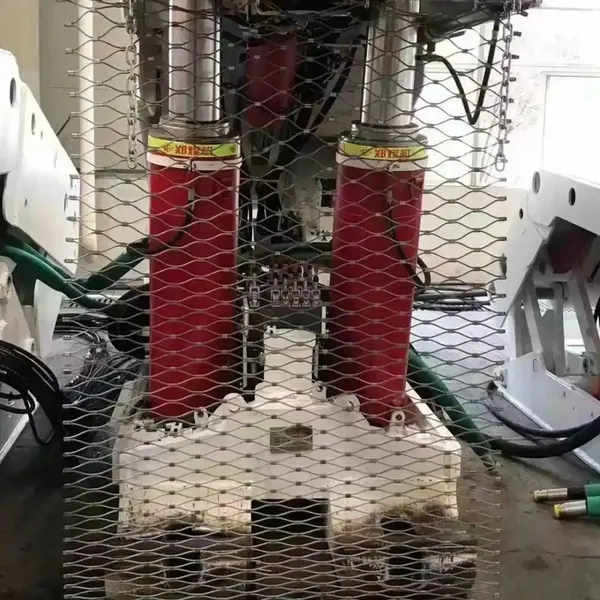 Read More
-
Coal Mine Hydraulic Support Protection Mesh and Working Face Safety
November 19, 2026Working face protection is a system rather than a product, and the mesh between the supports is one line of it. The other lines ar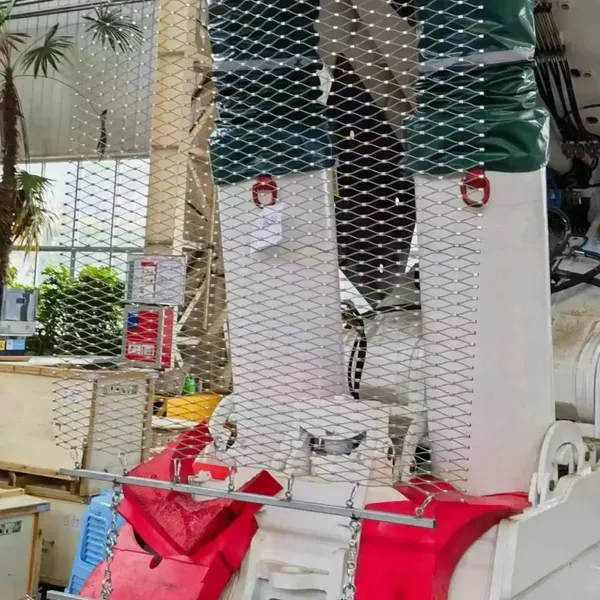 Read More
-
Specifying Black Oxide Stainless Steel Wire Rope Mesh: What to Send
November 18, 2026A dark net order fails for a small number of predictable reasons, and almost all of them are traceable to information that was not Read More
-
Cleaning and Handling Black Oxide Stainless Wire Rope Mesh
November 18, 2026Most of the damage done to a dark stainless net happens in two places, and neither of them is a defect in the panel. One is a buck Read More

Contact Us

Recommended Products
-
 Slope Protection System Rockfall Netting 2.0mm 3.0mm 4.0mm High Tensile Steel Wire Mesh Netting Rockfall BarriersUS$ 2 - 15MOQ: 1 Square Meter
-
Flexible Debris Flow Barrier Steel Rope Rockfall Barrier With Ring Diameter 350 mm China SupplierUS$ 5.9 - 40MOQ: 1 Square Meter
-
Custom Hexsteel Mesh for Refractory Linings Stainless Steel Wire Plain Weave Welded Cutting Welding Offered Made ChinaUS$ 9.20 - 45.00MOQ: 50 Square Meters
-
Double Twist Hexagonal Mesh Rockfall Netting Drapery System for for Rockfall Mitigation Slope Consolidation WorksUS$ 0.45MOQ: 100 Square Meters
-
China Factory Galvanized Steel Railway Side Slope Stabilization Net Woven Wire Mesh for Slope Protection Include Bending WeldingUS$ 15.00 - 20.00MOQ: 999 Square Meters


-
Galvanized Gabion Baskets for Retaining Wall Plain Weave Cutting Processing Service for Slope Stabilization-Free Sample OfferedUS$ 1.5 - 1.7MOQ: 1 Square Meter
-
Children's Playground Stainless Steel Rope Mesh Balcony Fence Inox Cable Net Build Guardrail Black Oxide Rope NettingUS$ 2.8MOQ: 1 Square Meter
-
Factory Direct Modern High Transparency Anti-Slip Stainless Steel Rope Mesh Stair Railing Woven Cable Netting Custom ProjectsUS$ 9.9 - 14.9MOQ: 1 Square Meter
-
Stainless Steel Rope Mesh for Backpack and Bag Anti Falling Dropring Mesh Inox Cable Net Anti-theft Black Oxide Rope NettingUS$ 118.00MOQ: 100 Square Meters
-
Heavy-Duty 4ftx5ft Drag Mat Factory With Chain Galvanized Steel Drag Mat for Tractor AttachmentUS$ 9.1 - 45MOQ: 1 Square Meter


-
High Altitude Anti Fall Woven Stainless Steel Wire Rope Net SS 304 316 316L Plain Weave Invisible Protective NetUS$ 9.9 - 14.9MOQ: 1 Square Meter
-
China Rope Mesh Manufacturer Customized SS316 Black Oxided Ferrule Type Rope MeshUS$ 5 - 20MOQ: 1 Square Meter
-
Baseball Field Dragging Lawn LevelingUS$ 59.00 - 66.00MOQ: 5 Pieces
-
316L Grade Stainless Steel Wire Mesh Sieves 200mm 300mm Screen Factory Price Sand Testing ScreenUS$ 4.7 - 15MOQ: 1 Piece
-
Outdoor Stainless Steel Cable Railing / Wire Rope Mesh / Wire Mesh Railings for BalconyUS$ 15.00 - 20.00MOQ: 100 Square Meters


-
Slope Protection System 65/3, High-tensile Steel Wire Mesh, Spike Plate, Rock Nail, Connection Clips T3 for Slope StabilityUS$ 1.80 - 3.00MOQ: 1 Square Meter
-
Pool Mesh Steeltex Paper-Backed Welded Wire Mesh Factory Price 12ga 16gaUS$ 40 - 70MOQ: 30 Rolls
-
G65 3 Rockfall Netting Rust Free Coated Slope Protection Net Galvanized High Tensile Wire Mesh Control Shallow LandslideUS$ 5.40 - 5.60MOQ: 1 Meter
-
Anti‑Drone Protection Steel Rope Net UAV Security Protection Fence Mesh Galvanized /Stainless Steel Customized ProductionUS$ 1.1 - 1.2MOQ: 100 Square Meters
-
Anti-Drone Netting, Galvanized High Tensile Steel Wire Rope Mesh, UVA Protection Net, CE Factory Customized ProductionUS$ 1.00 - 2.00MOQ: 999 Square Meters