Business License
Bridge Protection Mesh for Pedestrian and Landscape Bridges
A pedestrian bridge is a light structure carrying heavy behaviour, and its parapet is usually the lightest part of it.
That combination is why a pedestrian bridge net is a different product from the net on a road bridge, even where the two look alike in a photograph. The loads are smaller, the structure is more flexible, and the visual requirement is far stricter.
This article covers what makes a pedestrian bridge net different, the visibility argument that governs landscape bridge mesh, where a footbridge safety net belongs, the height and aperture that suit a climbing child, crowd loading, fixing to a slender structure, and two footbridges where the design changed after a trial.
1. What Makes a Pedestrian Bridge Net Different
A pedestrian bridge net is fixed to a structure that was designed to carry people and not much else, so the net has to be light in every sense.
The parapet on a footbridge is often a slender steel rail, a glass panel or a cable array. None of those was designed for a net tensioned at a kilonewton per metre, and a net that imposes one will pull the parapet out of line before anything else fails.
The usual solution is a self-supporting frame that carries the net tension within itself and is fixed to the deck rather than to the parapet. It looks heavier than a net tied to the rail and it puts the load where the deck can take it.
The second difference is deflection. A footbridge moves under a walking crowd, and a net tensioned hard to a flexible structure will slacken and tighten with that movement. Over a season the movement works the fixings loose, and the net that was tight at handover is hanging by the following spring.
2. Landscape Bridge Mesh and the Visibility Argument
Landscape bridge mesh is chosen for what it does not hide, and that is a design requirement as much as a structural one.
A bridge in a park or over a river is usually there partly to be looked through. A solid panel at the parapet turns a view into a wall, and a net at ninety percent open area almost disappears at a distance of twenty metres.
The wire diameter matters more than the open area for this effect. A net of three millimetre wire is visible as a texture; the same open area in one and a half millimetre wire is not visible at all until the viewer is close.
That has a structural consequence, because a thinner wire is a weaker wire. The way to keep both is to reduce the panel span by adding posts, rather than to thicken the wire and lose the effect.
3. Footbridge Safety Net: Where It Goes
A footbridge safety net has four possible positions, and a scheme usually needs two of them.
| Position | Duty | Typical detail |
|---|---|---|
| Above the parapet | Climb prevention | Vertical panel to 1.5 m, on posts |
| Infill between rails | Body and object passage | Panel clamped to the rail |
| Under the deck | Objects and spall | Horizontal, fixed to the girders |
| Beneath the walkway edge | Gap between deck and structure | Return panel down to the fascia |
The position that is most often argued about is above the parapet, because it changes the silhouette of the bridge. A local authority may accept it on a footbridge over a railway and refuse it on one over a river in a park, and the decision is usually made on appearance rather than on risk.
Where a full-height panel is refused, the alternative is an inward-angled top section, which is harder to climb and reads as part of the rail rather than as an addition.
That detail costs more per metre than a vertical panel and it is easier to justify at a planning stage, because it can be shown as a change to the rail rather than as a new element. It also sheds a person's weight inward rather than outward, which is the direction the deck can take it.
4. Height and Aperture in a Footbridge Safety Net
Height and aperture work together, and neither is much use without the other.
A net at a hundred millimetre aperture stops a body from passing and gives a small foot a hold at every wire crossing. That is why an anti-climb net is usually specified at a much smaller aperture than a fall prevention panel, often around forty to fifty millimetres.
The height is set by the rail below it. A net rising one and a half metres above a one metre parapet gives a total height of two and a half metres, which is beyond a casual climb, and it also looks like a fence rather than a barrier.
A net rising a metre above the same parapet gives two metres, which is climbable by a determined child using the wire as a ladder. The difference between the two schemes is often a single design meeting.
5. Landscape Bridge Mesh and the Deck Profile
Landscape bridge mesh has to follow a deck profile that is rarely straight, and the profile is where budgets are lost.
A curved deck in plan means every panel is a different width, and a cambered deck means every post is a different height. Both are made to measure, and both are priced per piece rather than per square metre.
The alternative is a series of straight panels set to a chord, which is cheaper and shows as a faceted line against a curve. On a small bridge that reads as a mistake, and on a long one it reads as a decision.
Hebei Longen Wire Mesh Products asks for the deck profile as a set of station coordinates rather than as a radius, because a radius alone cannot be checked against the structure and a set of stations can. Hebei Longen Wire Mesh Products Co Ltd returns a setting-out drawing for the posts before any panel is made.
6. Crowd Loading on a Footbridge
A footbridge parapet is designed for a crowd leaning against it, and a net added to that parapet has to be designed for the same crowd.
The load is applied at the top of the barrier and it is horizontal. A net fixed at the top of a post and at the deck transfers it as a bending moment into the post base, which is why the post spacing and the base plate are the structural items rather than the mesh.
A crowd also moves. The dynamic component of a walking crowd on a flexible footbridge is well known, and a net that is tensioned to the parapet changes the stiffness of the barrier and can shift its response.
That is a reason to fix to the deck through a frame rather than to the rail, and a reason to have the frame checked by the bridge engineer rather than by the net supplier.
A frame that is stiff enough for a crowd is also stiff enough to keep the net tension steady, and steady tension is what stops the fixings working loose over a season. The two requirements point the same way, which is not always the case on a bridge.
7. Pedestrian Bridge Net Fixing to a Slender Structure
Fixing a pedestrian bridge net to a slender structure is a question of spreading load rather than of choosing a bolt.
A single anchor into a thin wall or a hollow section will pull out under a crowd load, however good the anchor. The fixings that work are those that pass through the section and bear on both faces, or that clamp the section rather than penetrate it.
Clamping is the usual approach on a steel rail, with a shaped insert to match the profile. On a glass balustrade there is no clamping option, and the net has to be carried on its own posts set behind the glass rather than fixed to it.
A clamp also has to allow for the rail moving, which on a slender footbridge it will. A clamp that grips hard enough to resist movement will crack a coating; one that allows movement will wear the coating away slowly, and both are visible within a year.
Longen Wire Mesh Products supplies the clamp bodies and the shaped inserts as separate items for that reason, so that a footbridge safety net can be quoted from a survey of the rail profile rather than from a photograph.
8. Two Footbridges Where the Footbridge Safety Net Changed After a Trial
On a footbridge in a park, the first scheme used a net at a hundred millimetre aperture fixed to the top of a timber rail. The net stopped nothing that mattered, because the rail was climbable between the posts, and the panels were re-made at forty-five millimetres on a new steel frame set behind the timber.
On a station footbridge the first panels were fixed to the parapet posts and the parapet moved visibly under a test crowd. The panels were re-fixed to a frame carried on the deck, and the parapet returned to its designed line. The mesh was unchanged in both cases.
Hebei Longen Wire Mesh Products now asks for the parapet detail and the deck structure on any footbridge enquiry, and Longen will decline to quote a panel fixed to a rail that cannot take the tension.
9. Frequently Asked Questions
9.1 Can a pedestrian bridge net be fixed to a glass balustrade?
It can be carried in front of one and it cannot be fixed to one. Glass is not a material that accepts a clamp or an anchor, and drilling it removes the tempering that gives it strength. The workable detail is a frame of posts set behind the glass, fixed to the deck, with the net tensioned within that frame. The net then stands independent of the balustrade and the glass keeps its own structural role, so a scheme that shows a net bolted through a glass panel should be returned to the designer.
9.2 What height is needed above a footbridge parapet?
Enough that the total height above the walkway is beyond a casual climb, which in practice means about two and a half metres from the deck. Where the parapet is a metre high, the net adds one and a half metres, and where the parapet is a low rail of six hundred millimetres the net has to add more, at which point a full-height fence is usually the better answer. The height should be measured from the deck rather than from the top of the rail.
9.3 Does landscape bridge mesh need to be stainless?
It needs to be stainless where the environment will take a galvanised coating off faster than the maintenance cycle can replace it, which means coastal sites and bridges over salted roads. On an inland park bridge a heavy galvanised coating is usually enough, with stainless fixings. The fixings are the item that decides, because they hold water and they are where the coating is cut. A galvanised net with stainless fixings is a sound compromise on most landscape schemes, and it is the combination to cost first.
9.4 How much does a curved deck add to the cost?
It adds the setting out and the loss of repetition rather than a premium on the mesh. Every panel on a curve is a different width and every post a different height, so the works is doing one-offs rather than a batch. The saving available is to divide the curve into a small number of repeated panel widths and absorb the difference in the posts. That keeps some repetition and produces a line that still reads as a curve at normal viewing distance.
9.5 Is a footbridge safety net subject to vandalism?
It is, and the response is in the fixing rather than in the wire. A net held with bolts that can be undone from the walkway will be partly dismantled within a season, and a net held with security fixings or with concealed clamps will not. Cutting is rarer than unbolting, because cutting a tensioned net is noisy and unrewarding. The panels most at risk are those at the ends, where a person can reach both edges, and those are the ones to detail with a concealed fixing.
Recently Posted
-
Bridge Protection Mesh for Road and Rail Crossings
November 5, 2026A bridge over a live carriageway or a live railway is a structure where the thing below has priority, and every decision about the Read More
-
What Is Bridge Protection Mesh? Fall Prevention and Debris Control
November 5, 2026A bridge protection mesh is a wire or rope net fixed to a bridge structure to stop something leaving the deck, and what that somet Read More
-
How Hebei Longen Handles a Drone Protection Netting Project End to End
October 28, 2026A prison authority in Southeast Asia approved a drone net over two exercise yards, then discovered that the net could be delivered Read More
-
Inside Hebei Longen Wire Mesh Products: Rope Net Manufacturing in Anping County
October 28, 2026A buyer from Eastern Europe booked a factory visit before placing a first order, and asked to see the rope net bay rather than the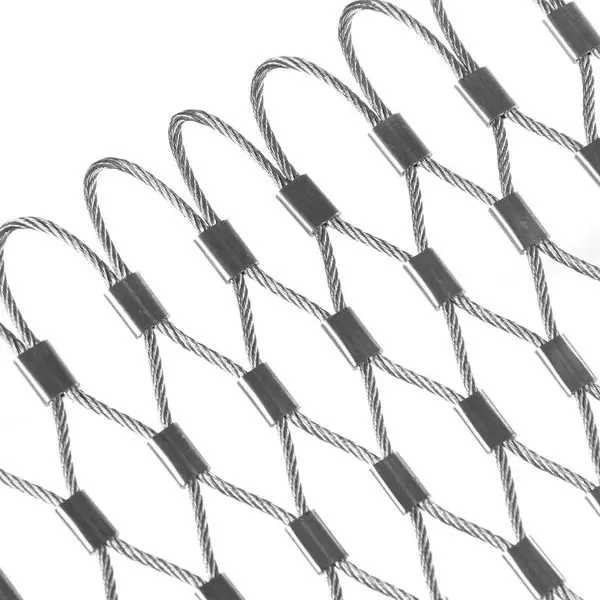 Read More

Contact Us

Recommended Products
-
 Slope Protection System Rockfall Netting 2.0mm 3.0mm 4.0mm High Tensile Steel Wire Mesh Netting Rockfall BarriersUS$ 2 - 15MOQ: 1 Square Meter
-
Flexible Debris Flow Barrier Steel Rope Rockfall Barrier With Ring Diameter 350 mm China SupplierUS$ 5.9 - 40MOQ: 1 Square Meter
-
Custom Hexsteel Mesh for Refractory Linings Stainless Steel Wire Plain Weave Welded Cutting Welding Offered Made ChinaUS$ 9.20 - 45.00MOQ: 50 Square Meters
-
Double Twist Hexagonal Mesh Rockfall Netting Drapery System for for Rockfall Mitigation Slope Consolidation WorksUS$ 0.45MOQ: 100 Square Meters
-
China Factory Galvanized Steel Railway Side Slope Stabilization Net Woven Wire Mesh for Slope Protection Include Bending WeldingUS$ 15.00 - 20.00MOQ: 999 Square Meters


-
Galvanized Gabion Baskets for Retaining Wall Plain Weave Cutting Processing Service for Slope Stabilization-Free Sample OfferedUS$ 1.5 - 1.7MOQ: 1 Square Meter
-
Children's Playground Stainless Steel Rope Mesh Balcony Fence Inox Cable Net Build Guardrail Black Oxide Rope NettingUS$ 118.00MOQ: 100 Square Meters
-
Factory Direct Modern High Transparency Anti-Slip Stainless Steel Rope Mesh Stair Railing Woven Cable Netting Custom ProjectsUS$ 9.9 - 14.9MOQ: 1 Square Meter
-
Stainless Steel Rope Mesh for Backpack and Bag Anti Falling Dropring Mesh Inox Cable Net Anti-theft Black Oxide Rope NettingUS$ 118.00MOQ: 100 Square Meters
-
Heavy-Duty 4ftx5ft Drag Mat Factory With Chain Galvanized Steel Drag Mat for Tractor AttachmentUS$ 9.1 - 45MOQ: 1 Square Meter


-
High Altitude Anti Fall Woven Stainless Steel Wire Rope Net SS 304 316 316L Plain Weave Invisible Protective NetUS$ 9.9 - 14.9MOQ: 1 Square Meter
-
China Rope Mesh Manufacturer Customized SS316 Black Oxided Ferrule Type Rope MeshUS$ 5 - 20MOQ: 1 Square Meter
-
Baseball Field Dragging Lawn LevelingUS$ 59.00 - 66.00MOQ: 5 Pieces
-
316L Grade Stainless Steel Wire Mesh Sieves 200mm 300mm Screen Factory Price Sand Testing ScreenUS$ 4.7 - 15MOQ: 1 Piece
-
Outdoor Stainless Steel Cable Railing / Wire Rope Mesh / Wire Mesh Railings for BalconyUS$ 15.00 - 20.00MOQ: 100 Square Meters


-
Slope Protection System 65/3, High-tensile Steel Wire Mesh, Spike Plate, Rock Nail, Connection Clips T3 for Slope StabilityUS$ 1.80 - 3.00MOQ: 1 Square Meter
-
Pool Mesh Steeltex Paper-Backed Welded Wire Mesh Factory Price 12ga 16gaUS$ 40 - 70MOQ: 30 Rolls
-
G65 3 Rockfall Netting Rust Free Coated Slope Protection Net Galvanized High Tensile Wire Mesh Control Shallow LandslideUS$ 5.40 - 5.60MOQ: 1 Meter
-
Anti‑Drone Protection Steel Rope Net UAV Security Protection Fence Mesh Galvanized /Stainless Steel Customized ProductionUS$ 1.1 - 1.2MOQ: 100 Square Meters
-
Anti-Drone Netting High Tensile Strength Stainless Steel Woven Wire Rope Mesh Active Rockfall Barrier Systemn Factory SupplyUS$ 15.00 - 20.00MOQ: 999 Square Meters