Business License
Inside Hebei Longen Wire Mesh Products: Rope Net Manufacturing in Anping County
A buyer from Eastern Europe booked a factory visit before placing a first order, and asked to see the rope net bay rather than the showroom. The tour took ninety minutes and ended in the packing area, where three crates were being marked for a zoo enclosure project. The order was placed the following morning.
That sequence is common enough to be worth explaining. Rope net buyers are not short of quotations, and the difference between two quotations is usually invisible on paper. It becomes visible when you watch a ferrule being swaged, a panel being measured, and a crate being closed.
This article describes how Hebei Longen Wire Mesh Products Co Ltd actually makes rope net, from the supply chain in Anping County through each production step and each inspection gate to the ports used for export. It is written as a factory walk-through rather than a brochure.
1. Anping Wire Mesh Manufacturer: Where the Rope Net Is Made
Anping County sits on the plain south of Beijing, in Hebei Province, and it is the densest wire mesh cluster in the country. Wire drawing, weaving, welding, hardware stamping and surface finishing all happen within a short drive of each other, which is why an anping wire mesh manufacturer can quote a delivery date that a trader sourcing from three provinces cannot match.
The cluster matters most when something changes mid-order. A customer asks for a heavier ferrule, or a different terminal, or a frame section that was not in the original drawing. In a cluster those changes are a phone call and a same-day collection, while in a distributed supply chain they are a re-quote and a week.
Longen Wire Mesh Products has worked inside that cluster for more than a decade, in a facility of 5,000 to 10,000 square metres with a team of 51 to 100 people. Rope net is one of the product lines made there, alongside the woven and welded mesh that gives the workshop its name.
2. Rope Net Factory Capability: Machines, Cells and Daily Output
Rope net factory capability is often described in tonnage, which tells a buyer very little. What matters is the sequence of cells and what each one can hold to tolerance. The table below lists the cells in the order that material moves through them.
Each cell has a defined output and a defined check, so a slow step shows up as a queue rather than as a mystery delay at the end of the month.
| Cell | Work performed | What is checked at the cell |
|---|---|---|
| Wire intake | Receiving, identification, storage by heat number | Diameter, surface condition, supplier documentation |
| Strand and rope | Stranding, rope lay, cut to length | Lay length, rope diameter, cut length |
| Ferrule and swage | Ferrule fitting, hydraulic swaging, pull sampling | Swage diameter, terminal alignment, sample pull result |
| Panel assembly | Lacing, aperture setting, edge finishing | Aperture over ten cells, panel squareness, edge condition |
| Frame and hardware | Cutting, drilling, finishing, trial fit | Hole position, section size, fit against the panel |
| Packing | Labelling, protection, crating | Label against packing list, crate integrity, moisture control |
Output is quoted per project rather than per month, because a bay making 20 mm aperture panels for balustrades runs at a very different rate from a bay making 80 mm panels for a facade. A single shift in the swaging cell typically completes somewhere between 60 and 120 panels depending on aperture, terminal type and whether the terminals are hand-fitted.
3. Stainless Rope Mesh Production from Wire Rod to Finished Panel
Stainless rope mesh production begins with the strand rather than with the rope. Seven or nineteen wires are stranded in one direction and then laid in the other, which is what gives the finished rope its resistance to rotation under load. A rope that unwinds when a terminal is fitted will never hold aperture.
The rope is cut to length with an allowance at each end for the ferrule, and the allowance is where inexperienced workshops lose money. Cut too short and the panel is scrap; cut long and the aperture drifts at the edge. Longen cuts to a template derived from the panel drawing rather than to a nominal length.
Swaging is the step that decides whether a panel holds its shape for a decade. The ferrule is compressed onto the rope to a controlled diameter, checked with a gauge rather than by eye, and sampled to destruction at a set frequency. A terminal that looks correct but is under-swaged will creep under sustained tension, and the symptom appears months later as a slack panel.
Assembly follows. Panels are laced with stainless wire or assembled with ferrules at the intersections, depending on the aperture and the load case. After assembly each panel is laid flat, measured across ten cells in both directions, checked for squareness against the diagonal, and labelled with its panel number so that it can be found again on site.
4. Inside the Quality Process: IQC, IPQC and OQC at the Anping Wire Mesh Manufacturer
Quality at an anping wire mesh manufacturer is usually described with a certificate, and a certificate says very little about a specific crate. What can be described is the three-gate process and the sampling that goes with it.
Incoming inspection covers wire diameter, surface condition and the supplier's documentation, with the heat number recorded so that a later question can be traced back to a coil. In-process inspection covers aperture, swage diameter, panel dimensions and edge condition at each cell, which is where most defects are caught cheaply.
Outgoing inspection happens on the packed unit rather than on the loose panel. Labels are checked against the packing list, panels are counted, crates are checked for moisture protection, and a sample set is opened if the order includes a mixed shipment.
The quality team runs at five to ten people, sized for the rope net and mesh lines rather than shared with unrelated production. Equipment includes a salt spray chamber for finish testing, a tensile tester for terminal samples, calibrated calipers and go and no-go gauges for aperture and swage diameter.
5. Rope Net Factory Capability in Custom Work and Prototypes
Most rope net orders are custom in some respect, and rope net factory capability is really a question about how custom work is handled rather than whether it is offered. The work starts with a drawing or, more often, with a photograph and three dimensions.
From that, the team produces a panel schedule: aperture, rope diameter, panel sizes, terminal type, edge treatment, frame interface and fixing points. The schedule goes back to the customer for confirmation before any material is cut, because a change at that stage costs nothing and a change after swaging costs a panel.
Prototypes and mock-up panels are a normal part of the flow. A single panel can be made to confirm the visual density of an aperture, to test a frame connection, or to check a terminal against a specific fixing. Prototype panels usually ship in seven to ten days, and the panel number is retained so that a later production run matches it.
Tolerances are agreed in the schedule rather than assumed. Panel size is normally held to plus or minus 2 mm, aperture to plus or minus 1 mm over ten cells, and frame hole position to plus or minus 1.5 mm. Where a project needs something tighter, the drawing says so and the panel is made on a jig.
6. Stainless Rope Mesh Production Capacity and Lead Times
Stainless rope mesh production runs on a quoted lead time per order rather than a catalogue dispatch date. Standard apertures in 304 or 316 rope with swaged terminals typically move through in fifteen to twenty-five days from drawing approval, and custom frames or unusual terminals add a week.
Two factors move that window. The first is material: 316 rope in an unusual diameter may need to be stranded to order, which adds days at the front end. The second is sequence: an order that arrives during a peak month queues behind work already on the floor, and a buyer who needs a fixed date should ask where the order will sit in that queue.
Longen plans the schedule backwards from the ship date, so the packing cell is booked before the swaging cell. That sounds like a detail and it is the reason a container does not sit half-loaded while the last crate is finished.
7. Packaging, Ports and Export from a Rope Net Factory
A rope net factory that exports regularly learns that the crate is part of the product. Panels are stacked flat with interleaving, coiled rope is bound at several points to prevent movement, and every package carries a label that matches the packing list and the panel schedule.
Frames and hardware travel separately from the mesh wherever possible, because a frame corner pressing against a panel for three weeks at sea produces a mark that looks like a defect on arrival.
Shipments leave through Tianjin and Qingdao, both within a day of the workshop by road. Tianjin suits North American and European sailings, Qingdao is often the better option for Southeast Asia and Oceania, and the choice is made per booking rather than by habit.
Export volume sits in the range of five to ten million US dollars a year, spread across North America, South America, Eastern Europe, Southeast Asia, Africa, Oceania, the Middle East, Eastern Asia, Western Europe, Central America, Northern Europe, Southern Europe, South Asia and the domestic market. In practice that means the documentation desk has seen most of the consular and certificate requests a new buyer is likely to raise.
8. Working with the Anping Wire Mesh Manufacturer on a First Order
A first order moves faster when the enquiry reaches the anping wire mesh manufacturer with four things: the application, the panel or area dimensions, the aperture and rope diameter if already decided, and the fixing or frame arrangement. Without those, the first two exchanges are spent establishing the brief.
From there the sequence is predictable. A panel schedule and drawing are issued, the customer confirms or amends, a prototype panel is offered where the visual result matters, and production is booked against a ship date.
Buyers who want to see the process are welcome to visit. A visit is most useful after the panel schedule exists, because the questions that arise in the rope net bay are specific: how the aperture is measured, how a terminal is sampled, how a crate is closed. Hebei Longen Wire Mesh Products arranges visits through the sales contact handling the enquiry, and the workshop is a short drive from the county's mesh trading district.
For a buyer comparing suppliers, the useful comparison is not the quotation total but the panel schedule behind it. Two quotes for the same elevation differ because one has a lighter terminal, a coarser aperture or a shorter edge allowance, and the schedule is where that becomes visible. Rope net factory capability shows up here as well, since a workshop that has made the detail before will flag the mismatch while it is still a drawing rather than a crate.
9. Frequently Asked Questions
9.1 What does an anping wire mesh manufacturer actually produce?
The county's output covers woven mesh, welded mesh, expanded metal, perforated sheet, gabion baskets, fence panels, filters and rope net, along with the wire drawing, hardware and surface finishing that feed them. Individual factories specialise: some weave, some weld, some assemble finished systems. An anping wire mesh manufacturer working in rope net will typically hold the stranding, swaging, assembly and frame cells under one roof, because those steps are hard to coordinate across separate workshops. Ask which cells are in-house before comparing quotations.
9.2 Can I visit the rope net factory before ordering?
Yes, and the visit is more useful after a panel schedule exists, because the conversation then turns on a specific panel rather than on general terms. Ask to see the swaging cell, the aperture measurement, the terminal sample log and the packing area, in that order. Those four stops answer most of the questions a first order raises, so allow half a day for the walk. Visitors are asked to bring safety shoes and to book ahead so that the bay is running production rather than being set up.
9.3 How is stainless rope mesh production inspected before shipment?
Three gates apply. Incoming inspection checks wire diameter and documentation and records the heat number, while in-process inspection checks aperture, swage diameter, panel dimensions and edge condition at each cell. Outgoing inspection works on the packed unit and checks labels, counts, crate protection and mixed-shipment contents. Terminal samples are pulled to destruction at a set frequency, and finish samples go into a salt spray chamber where the project calls for it, so ask for the inspection record rather than a generic certificate.
9.4 What is the minimum order for a custom rope net panel?
Prototype work starts at a single panel, which is why mock-ups are practical. Production orders are quoted per project, so the sensible question is not the smallest order but the smallest order that makes the material and setup worthwhile. A single panel in an unusual aperture may carry a setup charge, while twenty panels in a standard aperture usually do not. Send the drawing and the quantity and the answer comes back with the reasons attached, including whether a setup charge applies.
Recently Posted
-
How Hebei Longen Handles a Drone Protection Netting Project End to End
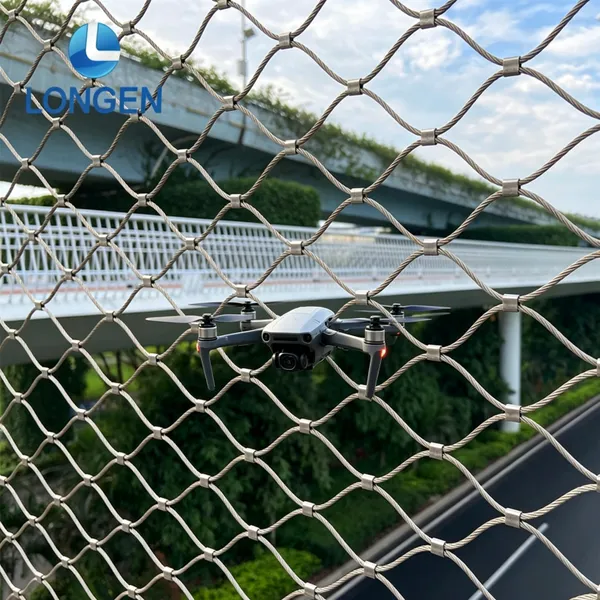
October 28, 2026A prison authority in Southeast Asia approved a drone net over two exercise yards, then discovered that the net could be delivered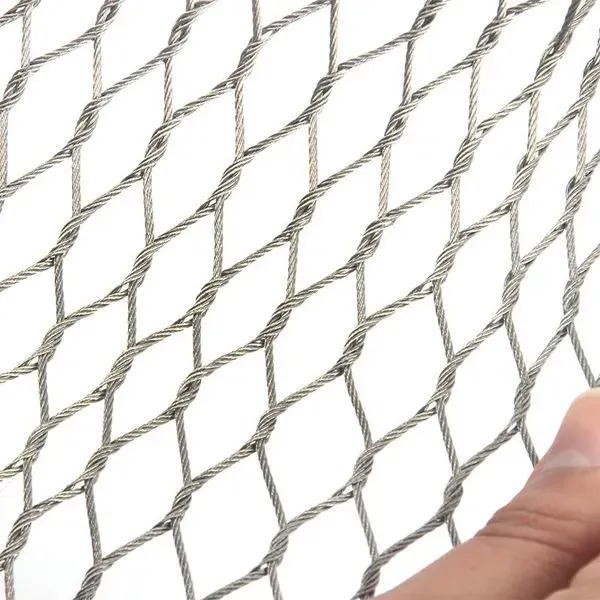 Read More
-
Architectural Rope Mesh in Green Building Facades: Daylight, Airflow and Safety
October 27, 2026A library extension in Northern Europe was specified with a metal screen across a fully glazed atrium. From the street the archite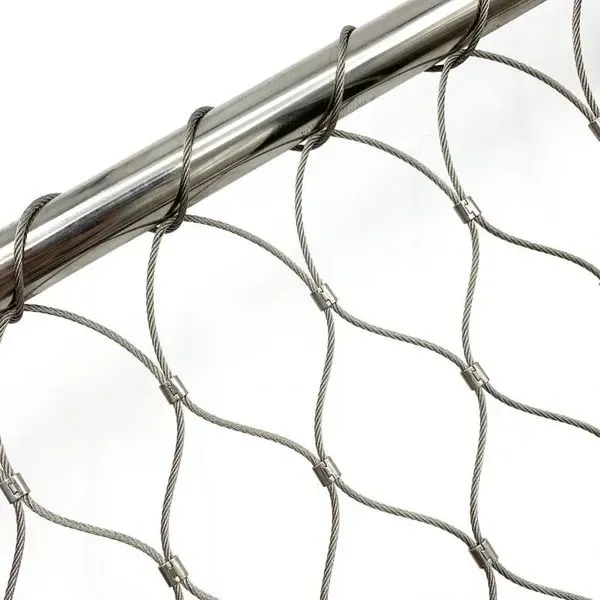 Read More
-
Framing and Tensioning Methods for Drone Protection Netting Installations
October 27, 2026A warehouse operator in Southeast Asia installed a drone net over a loading yard with a pole frame at 12 m centres and a rope net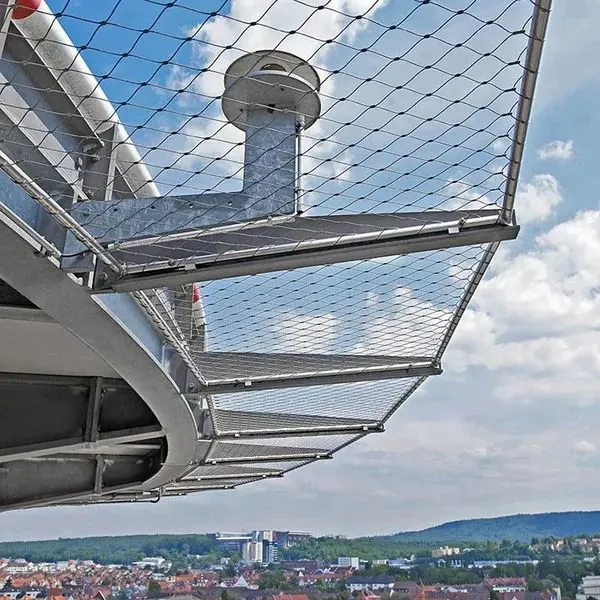 Read More
-
Packaging, Container Loading and Shipping for Stainless Rope Mesh Panels
October 27, 2026A hotel project in Central America received 60 rope mesh panels for a facade, packed flat and stacked four high in a 40 foot conta Read More

Contact Us

Recommended Products
-
 Slope Protection System Rockfall Netting 2.0mm 3.0mm 4.0mm High Tensile Steel Wire Mesh Netting Rockfall BarriersUS$ 2 - 15MOQ: 1 Square Meter
-
Flexible Debris Flow Barrier Steel Rope Rockfall Barrier With Ring Diameter 350 mm China SupplierUS$ 5.9 - 40MOQ: 1 Square Meter
-
Custom Hexsteel Mesh for Refractory Linings Stainless Steel Wire Plain Weave Welded Cutting Welding Offered Made ChinaUS$ 9.20 - 45.00MOQ: 50 Square Meters
-
Double Twist Hexagonal Mesh Rockfall Netting Drapery System for for Rockfall Mitigation Slope Consolidation WorksUS$ 0.45MOQ: 100 Square Meters
-
China Factory Galvanized Steel Railway Side Slope Stabilization Net Woven Wire Mesh for Slope Protection Include Bending WeldingUS$ 15.00 - 20.00MOQ: 999 Square Meters


-
Galvanized Gabion Baskets for Retaining Wall Plain Weave Cutting Processing Service for Slope Stabilization-Free Sample OfferedUS$ 1.5 - 1.7MOQ: 1 Square Meter
-
Children's Playground Stainless Steel Rope Mesh Balcony Fence Inox Cable Net Build Guardrail Black Oxide Rope NettingUS$ 118.00MOQ: 100 Square Meters
-
Factory Direct Modern High Transparency Anti-Slip Stainless Steel Rope Mesh Stair Railing Woven Cable Netting Custom ProjectsUS$ 9.9 - 14.9MOQ: 1 Square Meter
-
Stainless Steel Rope Mesh for Backpack and Bag Anti Falling Dropring Mesh Inox Cable Net Anti-theft Black Oxide Rope NettingUS$ 118.00MOQ: 100 Square Meters
-
Heavy-Duty 4ftx5ft Drag Mat Factory With Chain Galvanized Steel Drag Mat for Tractor AttachmentUS$ 9.1 - 45MOQ: 1 Square Meter


-
High Altitude Anti Fall Woven Stainless Steel Wire Rope Net SS 304 316 316L Plain Weave Invisible Protective NetUS$ 9.9 - 14.9MOQ: 1 Square Meter
-
China Rope Mesh Manufacturer Customized SS316 Black Oxided Ferrule Type Rope MeshUS$ 5 - 20MOQ: 1 Square Meter
-
Baseball Field Dragging Lawn LevelingUS$ 59.00 - 66.00MOQ: 5 Pieces
-
316L Grade Stainless Steel Wire Mesh Sieves 200mm 300mm Screen Factory Price Sand Testing ScreenUS$ 4.7 - 15MOQ: 1 Piece
-
Outdoor Stainless Steel Cable Railing / Wire Rope Mesh / Wire Mesh Railings for BalconyUS$ 15.00 - 20.00MOQ: 100 Square Meters


-
Slope Protection System 65/3, High-tensile Steel Wire Mesh, Spike Plate, Rock Nail, Connection Clips T3 for Slope StabilityUS$ 1.80 - 3.00MOQ: 1 Square Meter
-
Pool Mesh Steeltex Paper-Backed Welded Wire Mesh Factory Price 12ga 16gaUS$ 40 - 70MOQ: 30 Rolls
-
G65 3 Rockfall Netting Rust Free Coated Slope Protection Net Galvanized High Tensile Wire Mesh Control Shallow LandslideUS$ 5.40 - 5.60MOQ: 1 Meter
-
Anti‑Drone Protection Steel Rope Net UAV Security Protection Fence Mesh Galvanized /Stainless Steel Customized ProductionUS$ 1.1 - 1.2MOQ: 100 Square Meters
-
Anti-Drone Netting High Tensile Strength Stainless Steel Woven Wire Rope Mesh Active Rockfall Barrier Systemn Factory SupplyUS$ 15.00 - 20.00MOQ: 999 Square Meters