
 Business License
How Hebei Longen Handles a Drone Protection Netting Project End to End
A prison authority in Southeast Asia approved a drone net over two exercise yards, then discovered that the net could be delivered in five weeks while the anchor plates could not be cast for nine. The project lost a month, not because of the mesh, but because nobody had mapped the sequence from the first enquiry to the last bolt.
Drone netting project support is mostly sequence management. The net itself is a straightforward product; what decides whether a site is protected on time is the order in which drawings, approvals, fabrication, shipping and installation are arranged.
This article walks through that sequence as it runs at Hebei Longen Wire Mesh Products Co Ltd, from the enquiry to the first service visit, with the milestones, the documents and the points where projects usually slip.
1. Drone Netting Project Support: What Happens After the Enquiry
The first exchange is a scoping conversation rather than a quotation. Four questions come first: what the net has to stop, the area to be covered, the height available, and whether anything already stands on the site that can carry an anchor.
From the answers, the team proposes a configuration rather than a product. A yard of 40 m by 25 m at 8 m eaves will usually take a pole frame; the same area beside a warehouse wall may take a cable truss with one anchor on the building. Getting that choice right at the start removes most of the cost surprises later.
Within two working days the buyer receives a configuration note with a budget range, a preliminary panel count and the information still missing. Longen issues that note before any drawing so that the buyer can decide whether the scheme is worth engineering. That note is the point at which drone netting project support turns from a conversation into a schedule.
2. Custom Drone Net Engineering: From Site Survey to Panel Schedule
Custom drone net engineering starts with measurements that the buyer can usually take without help: span, height, the position and size of any obstruction, and the structure available for anchors. Photographs taken from each corner add more than a survey drawing often does.
Where the site is accessible, a survey visit resolves the anchor question properly. The engineer records the substrate, the fixing centres that the structure can accept, the overhead clearance for lifting, and the route a panel will travel from the gate to its final position.
The output is a panel schedule and a set of shop drawings. Each panel is numbered, sized, given an aperture and a rope diameter, and assigned a terminal type. Anchor reactions are stated so that the structural engineer can size the plates.
Drawing approval is the gate that protects both sides. Production does not start until the buyer returns a signed drawing, because a change to an approved drawing is a variation with a cost, while a change before approval is free.
3. Drone Barrier Delivery Schedule: The Twelve Milestones
A drone barrier delivery schedule is easier to hold when it is broken into milestones that each have an owner and a document. The table below is the sequence used on a typical project with a pole frame and a rope net infill.
Timings assume an approved drawing and a site that is ready to receive material, and they shift by a week or two on a cable truss that needs anchor design.
| Milestone | Typical timing | Owner | Document issued |
|---|---|---|---|
| Enquiry scoped | Week 1 | Buyer and supplier | Configuration note |
| Survey data complete | Week 1 to 2 | Buyer or surveyor | Dimension record and photographs |
| Panel schedule issued | Week 2 to 3 | Supplier engineering | Panel schedule and shop drawings |
| Drawing approved | Week 3 to 4 | Buyer | Signed drawing |
| Material released | Week 4 | Supplier production | Material release note |
| Prototype panel | Week 5 | Supplier production | Prototype photographs and measurements |
| Fabrication complete | Week 6 to 9 | Supplier production | Completion record |
| Pre-shipment inspection | Week 9 to 10 | Supplier quality | Inspection report |
| Packing complete | Week 10 | Supplier packing | Packing list with crate marks |
| Shipment booked | Week 10 to 11 | Supplier documents | Booking confirmation |
| Delivery on site | Week 12 to 15 | Buyer and forwarder | Arrival report |
| Installation and handover | Week 15 to 18 | Installer | Handover checklist |
Two milestones carry more weight than their position suggests. Drawing approval controls everything downstream, and pre-shipment inspection controls whether the crate can be closed. A project that slips at either one slips at every later line. Treat the drone barrier delivery schedule as a living document and update it at each milestone, since a schedule reviewed at the end has no value as a warning.
4. Custom Drone Net Engineering for Difficult Sites
Some sites cannot take a standard frame, and most custom drone net engineering effort goes into those. A rooftop over a live warehouse, a yard crossed by power lines, or a site where the sole available structure is a 300 mm wall each change the scheme rather than the panel.
Rooftops usually resolve into a ballasted frame. The poles sit on a beam grid loaded with blocks, and the ballast weight is calculated against uplift rather than against the net, which is why a rooftop scheme needs the roof structure checked before the frame is designed.
Power lines and pipe racks are handled by span rather than by height. Raising the frame above the obstruction is sometimes impossible, and the workable answer is a cable truss that crosses the obstruction in one span with the net hung below it, so that nothing metallic sits close to the line.
Where the sole support is a low wall, the engineering moves into the wall itself. A line of back-stays into the wall, or a frame tied to a new reinforced plinth, is often cheaper than a full independent foundation and is always faster to build.
5. Fabrication, Inspection and Packing for a Drone Barrier
Fabrication follows the approved panel schedule without modification. Panels are made in the sequence they will be installed, so that crate one opens onto the first bay rather than onto a random selection.
Inspection during fabrication covers the points that matter to a drone barrier: aperture over ten cells, rope diameter, swage diameter on every terminal sample, frame section and hole position, and the finish on any galvanised or coated part.
Packing is designed around the installation sequence as much as around protection. Frames are bundled by bay, panels are stacked flat with interleaving, and hardware is packed in labelled bags per bay so that a fitter does not have to sort a mixed box on a roof.
Longen Wire Mesh Products labels every crate with the bay numbers it contains, and the packing list carries the same numbers as the panel schedule. That single convention removes most of the site confusion that appears in the first week of an installation.
6. Drone Netting Project Support During Installation
Drone netting project support does not stop at the port. Installation guidance is issued with the shipment as a sequence document: set out the anchors, erect the frame, check plumb, install the edge cables, then hang the panels from one corner outward.
Questions during installation are answered within a working day by the same contact who handled the enquiry. Most of them concern a dimension that differs from the drawing because the site was built to a different tolerance, and the answer is usually a revised panel trim rather than a new panel.
Where an installation team has not handled rope net before, a short video call at the first bay saves more time than a written instruction. The team walks through the lacing pattern, the terminal orientation and the tension check on a finished bay, and the installer repeats it on site.
If a panel is damaged in transit, Hebei Longen Wire Mesh Products remakes it against the retained panel number rather than against a photograph. That is why the panel numbering is kept in the project file after shipment.
7. Drone Barrier Delivery Schedule Risks and How They Are Held
Four things push a drone barrier delivery schedule: late drawing approval, late site readiness, an anchor design that arrives after fabrication, and shipping-space shortages in a peak month.
Late approval is the most common and the easiest to avoid. A drawing that sits unsigned for ten days costs ten days, and no amount of production effort recovers them once the ship date is fixed.
Site readiness is harder because it sits with the buyer. The useful habit is to confirm two things before the container is booked: that the anchors or plinths are in place, and that lifting equipment will be on site on the delivery day.
Shipping pressure is handled by booking space as soon as the packing date is credible, and by splitting a large order across two sailings where the installation sequence allows it. Splitting is usually better than delaying a whole project for one late bay.
8. After Handover: Drone Netting Project Support in Service
Handover is a checklist rather than an event. Tension in each bay is measured and recorded, terminal positions are photographed, and the crate list is reconciled against the panel schedule so that spares are known. After handover, drone netting project support shifts from delivery to service and spares.
In service, the net needs a visual inspection at three months and twelve months, then every two years. The three month visit takes up initial settlement, which runs 3 mm to 8 mm per panel on most installations and shows up as a slight sag in the middle of a bay.
Spare hardware is worth holding. A bag of ferrules, a coil of lacing wire and two spare terminals cost very little against the cost of a service visit, and they let a site maintenance team deal with a damaged cell without waiting for a shipment.
Longen keeps the project file for each order, so a replacement panel ordered years later is made to the original schedule rather than to a measurement taken in poor conditions.
9. Frequently Asked Questions
9.1 How early should a drone netting project start before the required date?
Allow twelve to fifteen weeks from the first enquiry to a protected site, and longer if anchors have to be cast or a structural engineer has to approve plates. The net itself takes six to nine weeks from drawing approval, which means the front end of the schedule is where the risk sits. If the date is fixed, work backwards from the installation week and treat drawing approval as the milestone that must not move. Starting early costs nothing and buys the room to absorb a survey delay.
9.2 What information does a custom drone net engineering team need?
Five items carry most of the load: the area to be covered, the available height, the structure that can take an anchor, what the net has to stop, and any obstruction inside the span. Photographs from each corner plus a sketch with dimensions are enough to start. A site survey replaces guesswork for anchor design, and it is worth arranging before the drawing is issued rather than after. Send everything in one message and the panel schedule usually comes back within two weeks.
9.3 Who is responsible for the drone barrier delivery schedule?
It is shared, and that is why it slips. The supplier owns engineering, fabrication, inspection, packing and booking. The buyer owns drawing approval, site readiness, anchor installation and unloading. A schedule that names an owner for each milestone is far easier to hold than a single completion date, because the delay is attached to a party rather than to the project, so ask for the milestone table at quotation stage and review it weekly once fabrication begins, with the buyer's own approvals tracked as separate lines.
9.4 Can an existing fence or wall be used to support a drone net?
Often yes, and it is worth checking before a new frame is priced. A concrete wall can take back-stays at 3 m to 4 m centres, a steel fence post can carry a light net if the post is tied back, and a building facade can take a cable truss anchor at a floor slab. What the existing structure cannot do is take a load nobody calculated. Ask for the anchor reactions first, then have the structure checked against them rather than the other way round.
Recently Posted
-
Architectural Rope Mesh in Green Building Facades: Daylight, Airflow and Safety
October 27, 2026A library extension in Northern Europe was specified with a metal screen across a fully glazed atrium. From the street the archite Read More
-
Framing and Tensioning Methods for Drone Protection Netting Installations
October 27, 2026A warehouse operator in Southeast Asia installed a drone net over a loading yard with a pole frame at 12 m centres and a rope net Read More
-
Packaging, Container Loading and Shipping for Stainless Rope Mesh Panels
October 27, 2026A hotel project in Central America received 60 rope mesh panels for a facade, packed flat and stacked four high in a 40 foot conta Read More
-
How Stainless Steel Wire Rope Net Is Tested: Tensile, Salt Spray and Aperture Checks
October 26, 2026A contractor in the Gulf received 800 square metres of rope net for a hotel facade and asked for the test documents before install Read More

Contact Us

Recommended Products
-
 Slope Protection System Rockfall Netting 2.0mm 3.0mm 4.0mm High Tensile Steel Wire Mesh Netting Rockfall BarriersUS$ 2 - 15MOQ: 1 Square Meter
-
Flexible Debris Flow Barrier Steel Rope Rockfall Barrier With Ring Diameter 350 mm China SupplierUS$ 5.9 - 40MOQ: 1 Square Meter
-
Custom Hexsteel Mesh for Refractory Linings Stainless Steel Wire Plain Weave Welded Cutting Welding Offered Made ChinaUS$ 9.20 - 45.00MOQ: 50 Square Meters
-
Double Twist Hexagonal Mesh Rockfall Netting Drapery System for for Rockfall Mitigation Slope Consolidation WorksUS$ 0.45MOQ: 100 Square Meters
-
China Factory Galvanized Steel Railway Side Slope Stabilization Net Woven Wire Mesh for Slope Protection Include Bending WeldingUS$ 15.00 - 20.00MOQ: 999 Square Meters
-
Galvanized Gabion Baskets for Retaining Wall Plain Weave Cutting Processing Service for Slope Stabilization-Free Sample OfferedUS$ 1.5 - 1.7MOQ: 1 Square Meter
-
Children's Playground Stainless Steel Rope Mesh Balcony Fence Inox Cable Net Build Guardrail Black Oxide Rope NettingUS$ 118.00MOQ: 100 Square Meters
-
Factory Direct Modern High Transparency Anti-Slip Stainless Steel Rope Mesh Stair Railing Woven Cable Netting Custom ProjectsUS$ 9.9 - 14.9MOQ: 1 Square Meter
-
Stainless Steel Rope Mesh for Backpack and Bag Anti Falling Dropring Mesh Inox Cable Net Anti-theft Black Oxide Rope NettingUS$ 118.00MOQ: 100 Square Meters
-
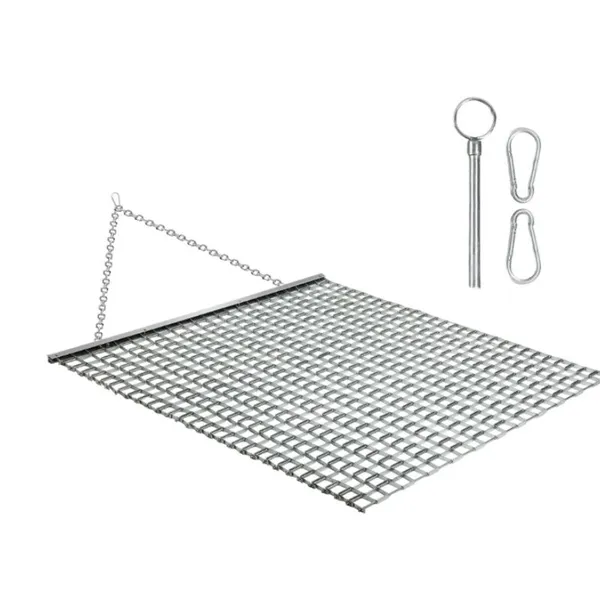
Heavy-Duty 4ftx5ft Drag Mat Factory With Chain Galvanized Steel Drag Mat for Tractor AttachmentUS$ 9.1 - 45MOQ: 1 Square Meter
-
High Altitude Anti Fall Woven Stainless Steel Wire Rope Net SS 304 316 316L Plain Weave Invisible Protective NetUS$ 9.9 - 14.9MOQ: 1 Square Meter
-
China Rope Mesh Manufacturer Customized SS316 Black Oxided Ferrule Type Rope MeshUS$ 5 - 20MOQ: 1 Square Meter
-
Baseball Field Dragging Lawn LevelingUS$ 59.00 - 66.00MOQ: 5 Pieces
-
316L Grade Stainless Steel Wire Mesh Sieves 200mm 300mm Screen Factory Price Sand Testing ScreenUS$ 4.7 - 15MOQ: 1 Piece
-
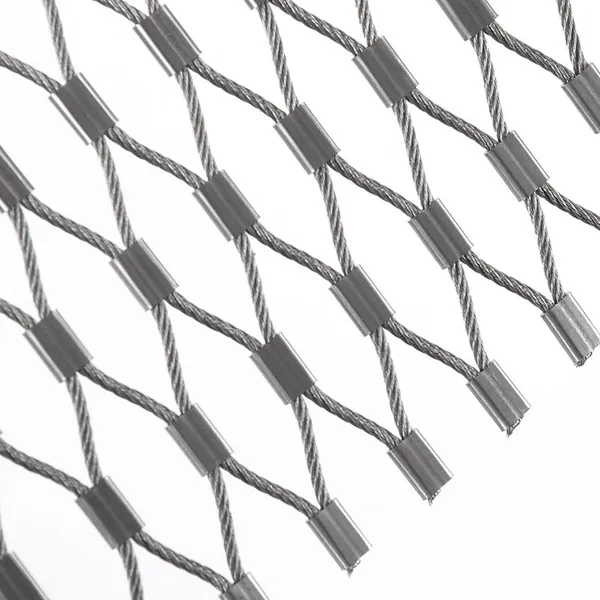
Outdoor Stainless Steel Cable Railing / Wire Rope Mesh / Wire Mesh Railings for BalconyUS$ 15.00 - 20.00MOQ: 100 Square Meters
-
Slope Protection System 65/3, High-tensile Steel Wire Mesh, Spike Plate, Rock Nail, Connection Clips T3 for Slope StabilityUS$ 1.80 - 3.00MOQ: 1 Square Meter
-
Pool Mesh Steeltex Paper-Backed Welded Wire Mesh Factory Price 12ga 16gaUS$ 40 - 70MOQ: 30 Rolls
-
G65 3 Rockfall Netting Rust Free Coated Slope Protection Net Galvanized High Tensile Wire Mesh Control Shallow LandslideUS$ 5.40 - 5.60MOQ: 1 Meter
-
Anti‑Drone Protection Steel Rope Net UAV Security Protection Fence Mesh Galvanized /Stainless Steel Customized ProductionUS$ 1.1 - 1.2MOQ: 100 Square Meters
-
Anti-Drone Netting High Tensile Strength Stainless Steel Woven Wire Rope Mesh Active Rockfall Barrier Systemn Factory SupplyUS$ 15.00 - 20.00MOQ: 999 Square Meters