Business License
Drone Protection Netting for Stadiums and Open Air Event Venues
A 40,000 seat stadium in Southern Europe added drone netting above one stand after a pitch invasion by a small quadcopter during a televised match. The net covered the stand, worked as designed, and left the playing surface and the opposite end open. The next incident came in over the corner flag.
A stadium drone protection net has an awkward duty, because the space that matters is not the seating but the air above the field. Covering 20,000 square metres above a bowl is a building project rather than a product purchase, and most venues end up covering a defined zone rather than the whole stadium.
These notes cover what a net can realistically cover, how event venue airspace netting is planned around a crowd, the permitting questions that differ between regions, and the case for an open air drone barrier at temporary events.
1. What a Stadium Drone Protection Net Has to Cover
A stadium drone protection net is usually specified for a zone rather than a stadium. The zone is the area above the field, the team benches and the broadcast positions, because that is where an aircraft causes the greatest disruption.
Covering the whole bowl is possible and rarely sensible. A 105 m by 68 m pitch with surrounds reaches roughly 20,000 square metres, and a net at 25 m above the surface at that scale needs a cable structure closer to a roof than to a fence.
The workable compromise on most existing venues is a net over one or two stands at 12 m to 18 m above the seating, which covers the approach an opportunist uses and leaves the far side to detection and stewarding.
New build venues have an advantage. Where the roof structure is already designed for a tensioned membrane, a net can hang from the same nodes at modest extra cost, and the design team should be told about the requirement before the roof steel is ordered.
2. Event Venue Airspace Netting and the Crowd Beneath
Event venue airspace netting carries a consequence that a roof net does not: a crowd beneath it. A captured aircraft, or a piece of the net itself, falls into an occupied area, so the design factor rises to 4.0 on the panel and the attachments.
The recovery plan is part of the safety case. A net above seating needs a route for removing an aircraft without dropping it, and a tether line on the aircraft side lets a steward lower a caught machine to a defined point rather than shaking it loose.
Panel size is limited by that plan. A 3 m by 3 m panel is manageable for two stewards, while a 6 m panel requires plant and a closure of the area, which is unacceptable during a match.
Access for installation is the other constraint. Most stadium nets are installed in the closed season over four to six weeks, and a late decision moves the work into the playing calendar where every hour costs more.
3. An Open Air Drone Barrier and the Geometry of an Oval Stand
An open air drone barrier over a curved stand has to follow a geometry that no rectangular panel schedule handles directly. The stand curves, the roof line rises and falls, and the net follows both.
Panels are usually developed as developable strips, each one a slightly different width. A 200 m long stand at 15 m height might use 40 strips of 5 m, and the factory presses each to its own dimension rather than cutting on site.
Purlins are the usual support on an existing roof. Where the roof has purlins at 6 m, the net can hang from them directly with a stainless cable at each purlin line, which avoids new steel and keeps the load path obvious to a structural engineer.
The low edge is where the design gets difficult. A net that finishes at the back of a stand leaves a gap above the concourse, and a return down to the rear wall closes it at the cost of another few hundred square metres.
4. Stadium Drone Protection Net Height and Support Options
Height above the seating sets the wind load and the visual impact. A net at 8 m above the front row covers a low approach, while 15 m covers a descending flight path, and each step up adds roughly 20 percent to the support steel.
Mast and cable is the least intrusive option on an existing stand. A 12 m mast at 30 m centres with a 10 mm cable between them carries the net with minimal new steel, and the masts can be set behind the last row where they are invisible from the pitch.
Broadcast positions need their own detail. A camera gantry at 20 m sits above most net heights, and a net that crosses the commentary position blocks a sight line that the broadcaster has paid for. Longen marks those positions on the layout so panels stop short of them rather than being cut on site.
Portal frames suit a new build or a stand with no roof. A steel portal at 20 m centres costs more than a cable system but tolerates a heavier net and a longer span without intermediate supports.
Hanging from an existing roof is the least expensive option where the structure allows it. It requires a structural check of the purlins and the nodes, and that check should happen before the net is specified rather than after the quotation.
5. Event Venue Airspace Netting Permits in Different Regions
Event venue airspace netting sits at the meeting point of building approval and aviation oversight, and the balance differs between regions. The table below describes the general pattern rather than any specific rule, and a venue should confirm requirements with its own authorities.
| Region | Typical approval route | What venues usually need |
|---|---|---|
| Western and Northern Europe | Building permit plus aviation notification | Structural calculations, height clearance, event safety plan |
| North America | Local building permit, aviation notice for tall structures | Engineer stamped drawings, crane and access plan |
| Middle East | Event authority approval with municipal permit | Structural submission, heat and wind data |
| Southeast Asia | Municipal permit, requirements vary by city | Structural report, typhoon or monsoon loading |
| Oceania | Building consent with aviation consultation | Wind loading to local standard, maintenance plan |
The common thread is structural evidence. Every region asks for calculations from a qualified engineer, and the differences lie in which authority reviews them and how long the review takes.
6. An Open Air Drone Barrier for Festivals and Temporary Sites
An open air drone barrier for a festival is a temporary structure with a different risk profile. It stands for a week, carries no snow and no long term fatigue, and is dismantled into a truck.
Modular panels suit that duty. A 3 m by 3 m panel with a bolted frame can be erected by four people in under an hour, and a 500 square metre stage cover comes down in a day with a small crew.
Ballast replaces foundations on a temporary site. Water ballast tanks or concrete blocks at 200 kg per post hold a 6 m barrier in winds up to 20 m per second, and the design has to state the wind speed at which the barrier is lowered or evacuated.
Storage and reuse decide the economics. A temporary barrier that survives three seasons pays for itself against hire, and panels that are rolled rather than folded last longer, because a fold in a rope net becomes a permanent kink.
7. Wind, Rain and Load on a Large Open Air Drone Barrier
Wind on a stadium net is not uniform. The stand itself accelerates flow over the roof line, and a net hung above the back of a stand can sit in a speed 25 percent higher than the open field beside it.
Permeability helps more than strength. A net at 95 percent open area sheds most of the pressure, and the design pressure on the mesh is a fraction of what a solid panel of the same size would see.
Rain adds weight and reduces that permeability for a short period. A heavy downpour wets the rope, closes part of the open area with a water film and adds roughly 0.1 kg per square metre, which is small against wind and worth noting in the calculation.
Thermal movement matters on a 200 m stand. A stainless cable expands by roughly 16 mm over 200 m across a 30 degree temperature swing, and the tensioning system has to absorb that without slackening the net.
8. Specifying a Stadium Drone Protection Net Before the Season
Start with the zone the venue can actually protect, then agree the honest coverage line with the safety officer. A net that covers two stands and says so is more useful than a design that claims the whole bowl and leaves the corners open.
Then confirm the structure. Purlins, nodes and roof capacity decide whether the net hangs from the existing roof or needs masts, and that decision changes the price by a factor rather than a percentage.
Finally, build the installation into the playing calendar. Longen Wire Mesh Products sequences stadium packages by stand so each week's delivery matches the area being closed, and the venue can keep one end open for maintenance while the other is netted.
Hebei Longen Wire Mesh Products Co Ltd supplies the panels, the edge cables and the tensioners as one package with the panel schedule marked by stand and by strip. Longen also provides the installation sequence drawing that the venue's safety team reviews before the first lift.
9. Frequently Asked Questions
9.1 How much of a stadium can a stadium drone protection net realistically cover?
Most installations cover a zone of 2,000 to 6,000 square metres rather than the whole bowl. The usual zone is the airspace above one or two stands and the field edge nearest them, at 12 m to 18 m above the seating. Covering a full 20,000 square metre bowl requires a cable structure comparable to a roof and a budget to match. A venue that plans in zones gets useful protection in the first season and can extend later without redesigning what it already has.
9.2 What safety factor applies to event venue airspace netting over a crowd?
A factor of 4.0 against the tested panel strength is the usual basis where people sit beneath the net, against 3.0 for a net over plant or a yard. The factor covers rope variability, thermal movement, corrosion loss and the uncertainty in the impact load. Attachments and anchors take the same factor, since a panel that holds while its bracket fails has not protected anyone. Some venues apply a higher factor again where the net hangs above a dense standing area at pitch level.
9.3 Is an open air drone barrier practical for a temporary event?
It is, provided the wind limit is written into the event plan. A modular 3 m panel with a bolted frame can be erected by four people in about an hour, and ballast at 200 kg per post holds a 6 m barrier in winds up to roughly 20 m per second. The design should state the speed at which the barrier is lowered, because a temporary structure that fails at a lower speed than the evacuation decision is a hazard rather than a protection.
9.4 Does a net above a stand affect the spectator view?
From the seats, a net at 12 m with 100 mm aperture and 2.5 mm rope is almost invisible against the sky, and it reads as a faint haze when looking up at a low angle. The supports affect the view more than the mesh, which is why masts are set behind the rear row rather than on the concourse. Photograph a sample against the sky from a seat before the order, because the mock up answers the question that no rendering settles.
Recently Posted
-
How Stainless Steel Wire Rope Net Is Tested: Tensile, Salt Spray and Aperture Checks
October 26, 2026A contractor in the Gulf received 800 square metres of rope net for a hotel facade and asked for the test documents before install Read More
-
Drone Protection Netting for Data Centers and Critical Facilities
October 26, 2026A colocation provider in Western Europe added drone detection to a campus of three data halls after a tenant asked for it in a con Read More
-
Zoo and Aviary Enclosures in Stainless Steel Cable Net: Design Notes
October 23, 2026A bird park in Northern Europe rebuilt its walk-through aviary with a stainless net at 60 mm aperture, chosen because the mesh loo Read More
-
Stainless Steel Wire Rope Net for Balcony and Staircase Fall Protection
October 23, 2026A residential refurbishment in a European city replaced 46 balconies of solid panel infill with glazed balustrades, and the client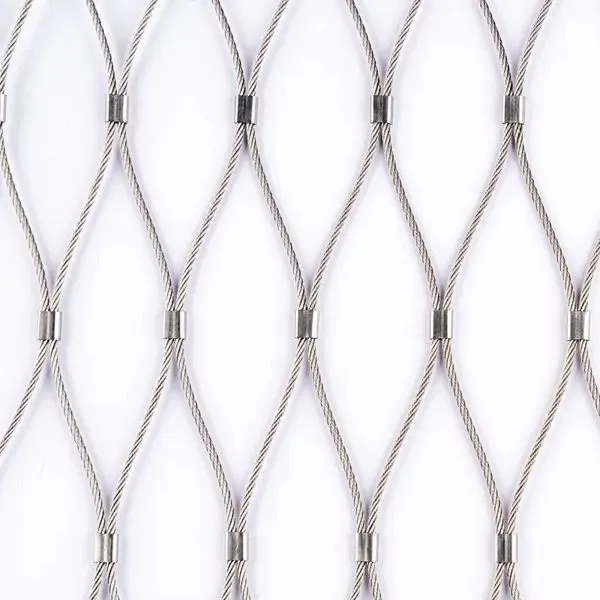 Read More

Contact Us

Recommended Products
-
 Slope Protection System Rockfall Netting 2.0mm 3.0mm 4.0mm High Tensile Steel Wire Mesh Netting Rockfall BarriersUS$ 2 - 15MOQ: 1 Square Meter
-
Flexible Debris Flow Barrier Steel Rope Rockfall Barrier With Ring Diameter 350 mm China SupplierUS$ 5.9 - 40MOQ: 1 Square Meter
-
Custom Hexsteel Mesh for Refractory Linings Stainless Steel Wire Plain Weave Welded Cutting Welding Offered Made ChinaUS$ 9.20 - 45.00MOQ: 50 Square Meters
-
Double Twist Hexagonal Mesh Rockfall Netting Drapery System for for Rockfall Mitigation Slope Consolidation WorksUS$ 0.45MOQ: 100 Square Meters
-
China Factory Galvanized Steel Railway Side Slope Stabilization Net Woven Wire Mesh for Slope Protection Include Bending WeldingUS$ 15.00 - 20.00MOQ: 999 Square Meters


-
Galvanized Gabion Baskets for Retaining Wall Plain Weave Cutting Processing Service for Slope Stabilization-Free Sample OfferedUS$ 1.5 - 1.7MOQ: 1 Square Meter
-
Children's Playground Stainless Steel Rope Mesh Balcony Fence Inox Cable Net Build Guardrail Black Oxide Rope NettingUS$ 118.00MOQ: 100 Square Meters
-
Factory Direct Modern High Transparency Anti-Slip Stainless Steel Rope Mesh Stair Railing Woven Cable Netting Custom ProjectsUS$ 9.9 - 14.9MOQ: 1 Square Meter
-
Stainless Steel Rope Mesh for Backpack and Bag Anti Falling Dropring Mesh Inox Cable Net Anti-theft Black Oxide Rope NettingUS$ 118.00MOQ: 100 Square Meters
-
Heavy-Duty 4ftx5ft Drag Mat Factory With Chain Galvanized Steel Drag Mat for Tractor AttachmentUS$ 9.1 - 45MOQ: 1 Square Meter


-
High Altitude Anti Fall Woven Stainless Steel Wire Rope Net SS 304 316 316L Plain Weave Invisible Protective NetUS$ 9.9 - 14.9MOQ: 1 Square Meter
-
China Rope Mesh Manufacturer Customized SS316 Black Oxided Ferrule Type Rope MeshUS$ 5 - 20MOQ: 1 Square Meter
-
Baseball Field Dragging Lawn LevelingUS$ 59.00 - 66.00MOQ: 5 Pieces
-
316L Grade Stainless Steel Wire Mesh Sieves 200mm 300mm Screen Factory Price Sand Testing ScreenUS$ 4.7 - 15MOQ: 1 Piece
-
Outdoor Stainless Steel Cable Railing / Wire Rope Mesh / Wire Mesh Railings for BalconyUS$ 15.00 - 20.00MOQ: 100 Square Meters


-
Slope Protection System 65/3, High-tensile Steel Wire Mesh, Spike Plate, Rock Nail, Connection Clips T3 for Slope StabilityUS$ 1.80 - 3.00MOQ: 1 Square Meter
-
Pool Mesh Steeltex Paper-Backed Welded Wire Mesh Factory Price 12ga 16gaUS$ 40 - 70MOQ: 30 Rolls
-
G65 3 Rockfall Netting Rust Free Coated Slope Protection Net Galvanized High Tensile Wire Mesh Control Shallow LandslideUS$ 5.40 - 5.60MOQ: 1 Meter
-
Anti‑Drone Protection Steel Rope Net UAV Security Protection Fence Mesh Galvanized /Stainless Steel Customized ProductionUS$ 1.1 - 1.2MOQ: 100 Square Meters
-
Anti-Drone Netting High Tensile Strength Stainless Steel Woven Wire Rope Mesh Active Rockfall Barrier Systemn Factory SupplyUS$ 15.00 - 20.00MOQ: 999 Square Meters