
 Business License
Blog Categories
What Is Ferrule Type Stainless Steel Wire Rope Mesh?
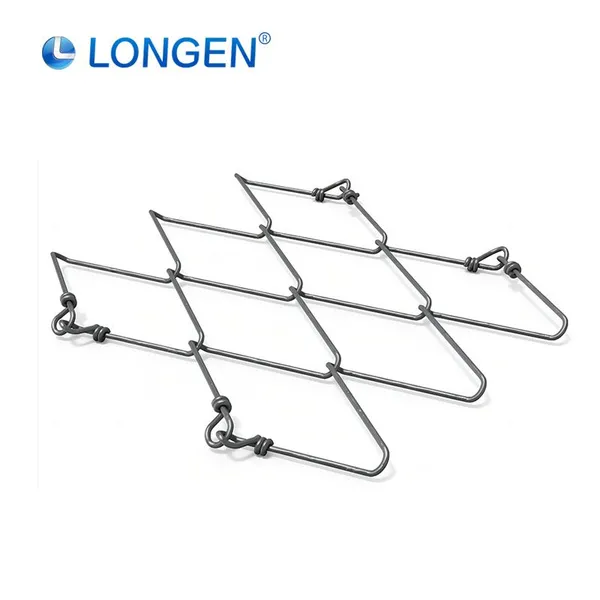
Ferrule type rope mesh is a stainless steel rope net in which the ropes are joined at every crossing by a pressed metal sleeve. The ropes do not knot around each other. A ferrule is placed over the two rope ends, a die closes it under pressure, and the joint holds by friction and by the deformation of the sleeve into the rope.
That single difference in the joint changes what the panel can be. A pressed joint allows a panel to be built flat on a jig, to be shaped into a curve after assembly, and to be replaced node by node. A knotted panel does none of those things as easily.
This article explains what a ferrule type rope mesh is, how a swaged ferrule net is assembled, what the term clip on cable mesh covers in different markets, where the product is specified, and what the joint cannot do.
1. What Ferrule Type Rope Mesh Is and How the Joint Closes
A ferrule type rope mesh is defined by its joint rather than by its pattern. The rope runs diagonally in two directions, the two directions cross at regular intervals, and each crossing is closed by a sleeve that is compressed onto both ropes.
The compression is what creates the connection. A hydraulic press drives a die onto the sleeve, the sleeve collapses onto the rope surface, and the resulting interference is what resists a pull. The joint is not welded, not glued and not tied.
Because the joint is a separate component, the panel can be assembled in a workshop on a flat jig and then formed into a shape. The ferrules stay closed through the forming, and the geometry of the panel changes without the joints changing.
The consequence for design is that a ferrule panel is a made-to-measure product. The aperture, the panel outline and the border are decided on a drawing, and the workshop builds to that drawing rather than cutting a roll of standard net.
2. Swaged Ferrule Net: The Three Parts of a Joint
A swaged ferrule net depends on three components that are easy to describe and hard to control: the sleeve, the die and the rope.
| Part | What it does | What goes wrong |
|---|---|---|
| Ferrule sleeve | Forms the connection by deformation | Wall too thin, wrong alloy, seam opens |
| Die | Controls the compressed shape and size | Worn die gives an undersized or oval swage |
| Rope | Provides the surface the sleeve grips | Wrong construction, uneven strand lay |
The sleeve is usually a seamless tube in a stainless grade matched to the rope, because a seamed tube can open along the weld under compression. The wall thickness is what gives the sleeve material to flow into the rope, and a thin wall produces a joint that looks correct and holds less.
The die decides the finished dimensions, and a die wears. A worn die produces a swage that is slightly long and slightly loose, and the change is gradual enough to pass a visual check. Die inspection is part of the process rather than a maintenance task.
The rope matters because a sleeve grips the outside of the strands. A rope with an uneven lay, or with a core that is much softer than the outer strands, compresses unevenly and the joint loses efficiency.
3. Clip On Cable Mesh: What the Term Covers
Clip on cable mesh is a name used in some markets for the same family of product, and the variation in terminology causes real confusion in enquiries. Three descriptions appear in specifications that describe the same construction.
The first is the pressed sleeve description, which names the ferrule and is the most precise. The second is the clipped joint description, which names the visual result: a small metal fitting at each crossing that appears to clip the ropes together. The third is the swaged terminal description, which comes from the cable industry and refers to the same operation applied to a terminal rather than to a mid-panel node.
None of the three names describes a different product. What differs is the size of the fitting, the number of ropes it closes, and whether it sits at a crossing or at the end of a run.
For an enquiry, the useful information is not the name but four facts: rope diameter, aperture measured across the flats, ferrule type, and whether the panel is flat or formed. Hebei Longen Wire Mesh Products asks for those four regardless of the term a client uses, because the term alone cannot be priced.
4. Where Ferrule Type Rope Mesh Is Specified
Ferrule type rope mesh appears in five families of work, and the reason it is chosen in each is the same: the panel has to be made to a shape rather than cut from a roll.
| Application | Why a ferrule joint suits it |
|---|---|
| Zoo and aviary enclosures | Panels follow curved roofs and irregular cage outlines |
| Railing infill | Aperture and border can be matched to a balustrade frame |
| Fall protection | Border terminals can be engineered and tested |
| Facade and interior screens | Large panels with a consistent diamond pattern |
| Three dimensional forms | Panels can be shaped after assembly |
The zoo case is the one that made the product common. An enclosure roof is rarely a flat rectangle, and a knotted panel cannot be pulled into a compound curve without distorting its apertures. A ferrule panel can be built flat and then formed over a frame, and the apertures stay close to their designed size.
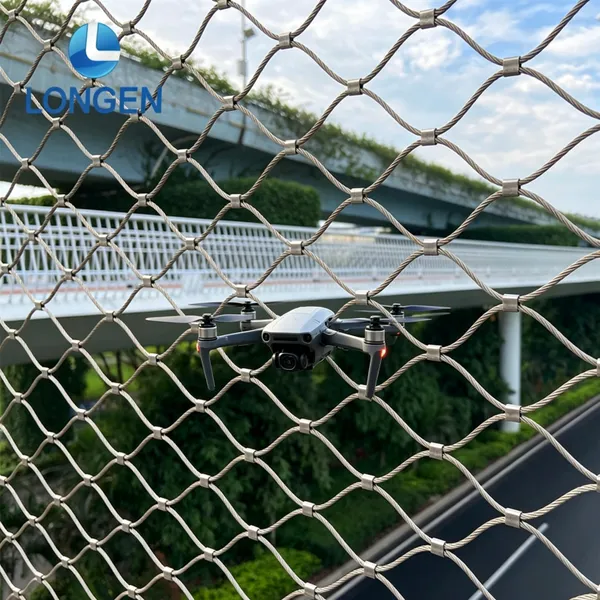
The railing case is different. There the panel is flat, and the ferrule is chosen because the border can be terminated with a tested fitting rather than a field knot. A clip on cable mesh panel in a balustrade also gives the designer an aperture that can be set to a rule rather than to whatever the roll happens to be. The joint at the edge is where a railing panel is loaded, and a pressed terminal is easier to verify than a splice.
5. Swaged Ferrule Net Against Woven Mesh: The Boundary
The comparison with woven mesh deserves a short boundary here, because the two products are often specified interchangeably and they are not interchangeable.
A woven panel is closed by the rope itself: each rope passes around the next and the knot is formed by the lay of the rope. There is no separate component, so there is nothing to press, nothing to inspect and nothing to corrode in a crevice.
A swaged ferrule net has a component at every crossing, which means a joint that can be inspected individually and replaced individually. That is an advantage in a zoo where one node is damaged by an animal, and a cost in a large flat screen where the nodes are a visual feature and nothing more.
The practical rule is that a formed or curved panel points to a ferrule, and a large flat panel with a fine aperture points to a weave. A project that needs both uses both, and the joint between them is a border rather than a transition.
6. How a Swaged Ferrule Net Panel Is Made
Production runs in a fixed order, and the order is what makes the joint repeatable.
The rope is cut to length with an allowance for the border, and the cuts are made with a shear that does not fray the strand ends. The ferrules are threaded and the panel is laid out on a jig that sets the aperture and the angle, which is usually sixty degrees for a diamond pattern and ninety degrees for a square one.
The press then closes the joints in a sequence that starts at the centre and works outward, so that the panel does not accumulate error toward one edge. Each joint is checked against a go and no-go gauge, and the gauge is checked against the die rather than against a sample.
The border is formed last, because it takes the accumulated tolerance of the panel. A border fitted before the field is closed has to be adjusted afterwards, and an adjusted border is a border with a mark on it.
7. What a Ferrule Joint Cannot Do
Three limits are worth stating before a specification is written, because each of them has produced a disappointment on a real project.
The first is efficiency. A pressed joint does not develop the full strength of the rope, and the reduction is stated as a percentage of the rope break load. A design that assumes the rope strength at the joint is a design that is wrong by that percentage everywhere.
The second is fatigue at the node. A ferrule creates a stiff point on a flexible rope, and a panel that flexes repeatedly at that point works the rope against the sleeve. On a windy facade or a gate that is used constantly, the node is where a broken wire appears first.
The third is field adjustment. A woven panel can be re-tensioned by working the knot. A ferrule panel cannot, because the joint has been closed once and reopening it destroys the connection. Tension on a ferrule panel is taken at the border, which is why the border detail matters more than it does on a woven panel.
8. Ordering and Checking a Clip On Cable Mesh Panel
An order for a clip on cable mesh panel should be placed against a drawing rather than against an area, and the drawing should carry five items.
The first is the panel outline with dimensions taken on site, not from a general arrangement. The second is the aperture with the direction in which it is measured. The third is the rope diameter and grade, stated as a measured figure rather than a nominal one.
The fourth is the border type and the terminal, including whether the terminal is a pressed eye or a ferrule onto a rod. The fifth is the finish, which for stainless rope mesh is usually a natural pickled surface or a black oxide, and which has to be stated because the two read differently on a building.
At goods-in, three checks catch most of what goes wrong: measure the aperture across the flats, measure the rope with a micrometer, and pull one sample joint to its stated load. Longen Wire Mesh Products supplies a joint test record with each batch, Longen keeps the press settings with the same record, and Hebei Longen Wire Mesh Products Co Ltd keeps the die identification against the batch so that a later panel can be matched to the same tooling.
9. Frequently Asked Questions
9.1 Is a ferrule joint weaker than a knot?
It depends on the knot, and the honest answer is that both are reductions on the rope. A well-formed ferrule develops a high proportion of the rope strength and does so consistently, because the compression is set by a die rather than by a pair of hands. A knot varies with the operator, and a knot in a stiff rope can be the weaker of the two. The figure that matters is the tested efficiency of the joint that is actually supplied.
9.2 Can a ferrule panel be cut on site to fit?
Not without destroying the joints along the cut line, because every crossing on that line has to be opened. A panel can be trimmed at a border where the border is re-terminated, and the field cannot be trimmed without rebuilding it. This is why the panel schedule matters: a panel made to a measured outline needs no site cutting, and a panel cut on site is a panel with new joints of unknown quality. Where an opening has been altered after the survey, the correct response is a new panel rather than a pair of bolt cutters.
9.3 What rope diameters are used for ferrule mesh?
Most building and enclosure work falls between one millimetre and four millimetres, with larger diameters used where the panel is structural or where the aperture is coarse. The diameter is chosen with the aperture rather than on its own, because the two together set the openness and the load capacity. A supplier who quotes a diameter without the aperture has given half of the specification. The rule of thumb is that a coarser aperture needs a heavier rope to keep the panel stable, and a finer aperture in a heavy rope becomes a stiff plate rather than a net.
9.4 Does the ferrule have to be the same grade as the rope?
It should be, and for two reasons. A matching grade avoids a galvanic couple in a joint that stays damp, and it avoids a hardness mismatch that changes how the sleeve grips. A sleeve that is much harder than the rope will not deform into the strands, and a sleeve that is much softer will crush without gripping. Both are visible in a pull test and neither is visible in a photograph, so the certificate is worth reading: check that the sleeve alloy on it matches the rope grade stated on the same document rather than on a separate sheet.
Recently Posted
-
How Longen Ships a Fall Protection Safety Net Project Clean
November 27, 2026A contractor in Oceania ordered a net for three rooftop plant areas and received one crate, one packing list and no panel referenc Read More
-
Specifying Fall Protection Safety Net for Public and Municipal Projects
November 27, 2026A city authority in Western Europe tendered a safety net package for four schools and a sports hall, and received five bids that c Read More
-
Inspecting and Re-tensioning a Fall Protection Safety Net
November 26, 2026Six years after installation, a shopping centre in Southeast Asia booked an inspection because a facilities manager had noticed th
Read More -
Fall Protection Safety Net for Atriums, Stairs and Lift Shafts
November 26, 2026A hotel in Eastern Europe had a six storey atrium with a glass roof, a cantilevered walkway on each level, and no protection betwe Read More

Contact Us

Recommended Products
-
 Slope Protection System Rockfall Netting 2.0mm 3.0mm 4.0mm High Tensile Steel Wire Mesh Netting Rockfall BarriersUS$ 2 - 15MOQ: 1 Square Meter
-
Flexible Debris Flow Barrier Steel Rope Rockfall Barrier With Ring Diameter 350 mm China SupplierUS$ 5.9 - 40MOQ: 1 Square Meter
-
Custom Hexsteel Mesh for Refractory Linings Stainless Steel Wire Plain Weave Welded Cutting Welding Offered Made ChinaUS$ 9.20 - 45.00MOQ: 50 Square Meters
-
Double Twist Hexagonal Mesh Rockfall Netting Drapery System for for Rockfall Mitigation Slope Consolidation WorksUS$ 0.45MOQ: 100 Square Meters
-
China Factory Galvanized Steel Railway Side Slope Stabilization Net Woven Wire Mesh for Slope Protection Include Bending WeldingUS$ 15.00 - 20.00MOQ: 999 Square Meters
-
Galvanized Gabion Baskets for Retaining Wall Plain Weave Cutting Processing Service for Slope Stabilization-Free Sample OfferedUS$ 1.5 - 1.7MOQ: 1 Square Meter
-
Children's Playground Stainless Steel Rope Mesh Balcony Fence Inox Cable Net Build Guardrail Black Oxide Rope NettingUS$ 2.8MOQ: 1 Square Meter
-
Factory Direct Modern High Transparency Anti-Slip Stainless Steel Rope Mesh Stair Railing Woven Cable Netting Custom ProjectsUS$ 9.9 - 14.9MOQ: 1 Square Meter
-
Stainless Steel Rope Mesh for Backpack and Bag Anti Falling Dropring Mesh Inox Cable Net Anti-theft Black Oxide Rope NettingUS$ 118.00MOQ: 100 Square Meters
-
Heavy-Duty 4ftx5ft Drag Mat Factory With Chain Galvanized Steel Drag Mat for Tractor AttachmentUS$ 9.1 - 45MOQ: 1 Square Meter
-
High Altitude Anti Fall Woven Stainless Steel Wire Rope Net SS 304 316 316L Plain Weave Invisible Protective NetUS$ 9.9 - 14.9MOQ: 1 Square Meter
-
China Rope Mesh Manufacturer Customized SS316 Black Oxided Ferrule Type Rope MeshUS$ 5 - 20MOQ: 1 Square Meter
-
Baseball Field Dragging Lawn LevelingUS$ 59.00 - 66.00MOQ: 5 Pieces
-
316L Grade Stainless Steel Wire Mesh Sieves 200mm 300mm Screen Factory Price Sand Testing ScreenUS$ 4.7 - 15MOQ: 1 Piece
-
Outdoor Stainless Steel Cable Railing / Wire Rope Mesh / Wire Mesh Railings for BalconyUS$ 15.00 - 20.00MOQ: 100 Square Meters
-
Slope Protection System 65/3, High-tensile Steel Wire Mesh, Spike Plate, Rock Nail, Connection Clips T3 for Slope StabilityUS$ 1.80 - 3.00MOQ: 1 Square Meter
-
Pool Mesh Steeltex Paper-Backed Welded Wire Mesh Factory Price 12ga 16gaUS$ 40 - 70MOQ: 30 Rolls
-
G65 3 Rockfall Netting Rust Free Coated Slope Protection Net Galvanized High Tensile Wire Mesh Control Shallow LandslideUS$ 5.40 - 5.60MOQ: 1 Meter
-
Anti‑Drone Protection Steel Rope Net UAV Security Protection Fence Mesh Galvanized /Stainless Steel Customized ProductionUS$ 1.1 - 1.2MOQ: 100 Square Meters
-
Anti-Drone Netting, Galvanized High Tensile Steel Wire Rope Mesh, UVA Protection Net, CE Factory Customized ProductionUS$ 1.00 - 2.00MOQ: 999 Square Meters