
 Business License
Blog Categories
How Longen Ships a Fall Protection Safety Net Project Clean
A contractor in Oceania ordered a net for three rooftop plant areas and received one crate, one packing list and no panel references. The crates arrived on a Friday, the crew started on Monday, and the first two days went on matching panels to openings by measuring them on the roof. The net itself was fine. The delivery was not.
That story is told by buyers about many suppliers, and it is the reason a project is judged on how it arrives as much as on how it was made. A fall protection net supplier that ships clean gives the installer a sequence, a reference on every panel and a document set that matches the crates.
This article describes how Hebei Longen Wire Mesh Products Co Ltd runs a net project from enquiry to handover: how custom safety net production is scheduled, what the safety net delivery schedule contains, how panels are packed for sea freight, and where the supplier's responsibility ends on site.
1. What a Fall Protection Net Supplier Should Handle
The scope of a supplier is wider than most buyers assume at enquiry stage. It starts with the panel schedule and ends with a handover pack, and the middle contains the parts that decide whether the installation runs smoothly.
A good fall protection net supplier will read the drawings, question the dimensions that do not close, propose an aperture and rope that suit the duty, and confirm the fixing arrangement against the structure. That conversation usually takes a week and saves a month.
Longen works from the drawings rather than from a product list. Where a drawing shows an opening that a standard panel will not fill, the answer is a schedule line rather than a site cut.
The scope also includes the awkward items: spare ferrules, a patch panel, matching rope and a maintenance sheet. They cost little at the factory and a great deal once the container has sailed.
2. Custom Safety Net Production: From Drawing to Panel
Custom safety net production starts when the panel schedule is signed off, not when the order is placed. The gap between those two events is where most delays are born.
Each panel is cut, terminated and labelled in the workshop. The label carries the panel reference from the schedule, the size and the level, so that the crate and the drawing agree when the installer opens it.
Rope is drawn from a traced batch. Longen records the heat number of the wire and the batch of the rope against each order, which is what allows a certificate to mean something two years later.
Ferrules are pressed on a calibrated press and sampled to destruction at a set frequency. A terminal that passes a proof load at the start of a run and not at the end is a press problem rather than a rope problem, and the sampling catches it.
Custom safety net production also absorbs the changes that arrive mid-build. A revised opening, a shifted column or a new plant unit all land on the schedule, and the workshop either has a revision process or it improvises.
Longen reissues the schedule at each revision and marks the affected panels, so that a buyer can see which crates moved rather than being told that everything has changed.
3. The Safety Net Delivery Schedule
A safety net delivery schedule is a document, not an estimate. It lists each crate, what is inside it, the panel references it contains and the date it is due to leave the workshop.
The schedule is built backwards from the installation date, with fabrication, packing, inland transport and sea freight each taking their own slot. A buyer who gives a handover date and works backwards gets a plan; one who gives a shipping date gets a guess.
Longen issues the schedule with the order confirmation and revises it at each approved drawing revision. A revision that adds panels moves the later crates rather than the whole shipment, which keeps the first delivery on time.
For a phased site, the crates follow the erection or installation sequence rather than the drawing order. That is the single arrangement that most improves the first week on site.
4. Custom Safety Net Production and Packing
Packing is where a panel either arrives flat or arrives with a memory of the journey. Cable net is flexible, and a panel that has been folded hard will keep the fold for weeks.
Panels are rolled rather than folded, on a diameter that suits the rope and the aperture. A 4 mm rope at 50 mm aperture rolls comfortably, while a 6 mm rope at a coarse aperture needs a larger diameter to avoid a permanent set.
Each roll is wrapped, labelled and stood in the crate rather than laid flat, so that the weight of the stack does not press on the panel below. Crate interiors are lined to protect the finish.
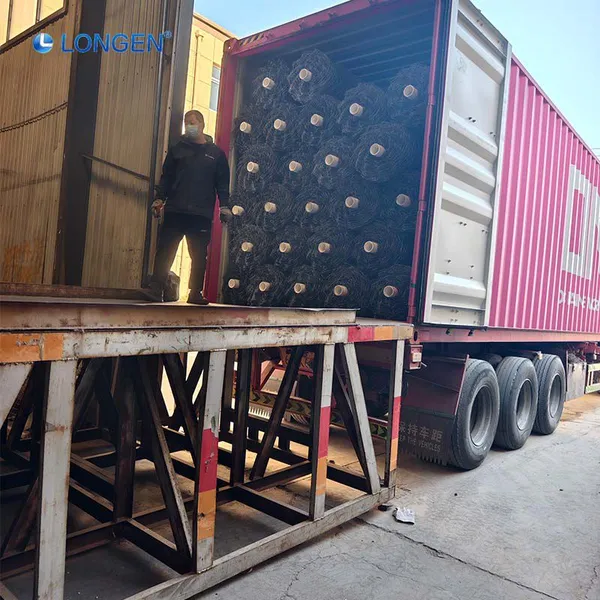
Mixed shipments are separated by level, with the first crate to be opened placed last in the container. That detail is planned on the packing list, not discovered at the port.
The safety net delivery schedule also fixes what happens at the destination port. A buyer who has the crate list in advance can book a crane, a truck and a store, rather than discovering on arrival that the container holds eleven crates and the yard has room for four.
That planning is the part a fall protection net supplier can support without being on site, simply by issuing accurate weights and dimensions before the container is sealed.
5. Safety Net Delivery Schedule Documents
The document set travels with the goods and arrives by email before them. It usually contains the commercial invoice, the packing list, the panel schedule, the certificates and the installation instructions.
The packing list and the panel schedule should be read together. One says what is in the crate; the other says where it goes, and a site that has one without the other will spend a day guessing.
| Document | Purpose | Who uses it |
|---|---|---|
| Panel schedule | Panel reference, size, level and position | Installer, site manager |
| Packing list | Crate contents and weights | Customs, site stores |
| Anchor layout | Fixing positions and reactions | Structural engineer, installer |
| Certificates | Rope, terminal and alloy traceability | Client, inspector |
| Installation notes | Tension figures and sequence | Installation crew |
A buyer should be able to hand the first two documents to a site team and have the crates opened in the right order. If that is not possible, the set is incomplete.
6. Where a Fall Protection Net Supplier Stops
A supplier's responsibility ends at the point agreed in the contract, and it is worth writing that point down. For an export order it is usually the port of loading, and for a project order it may be the site gate.
Longen ships from Tianjin and Qingdao and handles export documentation, fumigation where required and container loading. Installation is by the buyer's crew or a local contractor, supported by the installation notes and, where the project justifies it, a remote walkthrough.
The handover point matters for insurance. A panel damaged between the port and the site is a claim against the carrier, and the photographs taken at loading are the evidence that makes the claim work.
A fall protection net supplier that photographs every crate at loading also builds a record of what left the factory in what condition. That record is worth more than any argument about a dented panel six weeks later.
Longen photographs each crate at loading with the seal visible. It takes twenty minutes and settles most disputes before they start.
7. Custom Safety Net Production Lead Times
Lead time is a function of three things: the quantity, the construction and the finish. A standard ferruled panel in 304 ships in weeks, while a woven panel in 316 with a black oxide finish takes longer because the work is slower at every stage.
Quantity matters less than variety. Ten identical panels are quicker than ten different ones, because the workshop sets up once. A schedule with many bespoke sizes takes longer than its area suggests.
Longen quotes lead time in working days from drawing approval rather than from order date, since the drawing stage is the one the buyer controls. That convention makes the commitment honest on both sides.
8. Choosing a Fall Protection Net Supplier
Four questions separate a supplier from a trader. Ask where the panels are made, ask for a panel schedule from a recent project, ask how the rope batch is traced, and ask what arrives in the crate besides the net.
The answers are quick to check. A trader will answer the first question vaguely and the fourth with a brochure. A manufacturer will send a schedule with references and levels on it, because that document already exists.
Longen Wire Mesh Products has been making cable net in Anping County, Hebei, for more than a decade, with a workshop of five thousand to ten thousand square metres and a quality team of five to ten people. Those numbers are modest, and they are the reason a project gets a named contact rather than a ticket number.
Custom safety net production capacity is the other question worth asking, because a supplier who is booked for three months will quote a lead time that suits the workshop rather than the project. Ask how many panels a week the line can produce at the aperture you need.
Ask for the inspection record from the last order as well. A supplier who can produce one without asking is a supplier with a system, and that is the thing a buyer is really testing.
9. Frequently Asked Questions
9.1 Can I order a mixed container with several panel types?
Yes, and most projects do. Mixed containers are packed by level or by installation phase, with the crate order shown on the packing list. Send the schedule with the references grouped the way the site will work, and the packing follows it. Allow an extra week for a heavily mixed order, since the workshop sequences panels by type to avoid repeated set-ups, and that planning is part of the lead time, so send the schedule sorted by aperture and rope as well as by reference.
9.2 What is the minimum order for custom panels?
There is no fixed minimum, and small orders become uneconomic because of fixed costs rather than material. A single bespoke panel carries the same drawing, set-up and export paperwork as a hundred. For a small requirement, ask for a stock size that is close to the opening and plan the frame around it, which is usually cheaper than a bespoke panel plus a crate. Where the opening cannot move, order two panels rather than one, so that a spare is already on site.
9.3 How are panels protected during sea freight?
Panels are rolled, wrapped, stood upright in a lined crate and braced so that they cannot move. The crate is photographed at loading with the seal visible. On arrival, check the seal number against the packing list before opening, and photograph any damage before the crate is dismantled, since a carrier claim depends on that evidence being recorded at the right moment. Keep the crate braced until the panels are needed, because a crate that is opened and left standing in a windy yard is how a flat panel becomes a bent one.
9.4 Does Longen install the net overseas?
Installation is carried out by the buyer's crew or a local contractor. Longen supports it with installation notes, a tension figure per panel and, where the project justifies it, a video walkthrough of the sequence. For a first order in a new market, a supervisor visit can be arranged and is usually worth it on an atrium or a lift shaft where the geometry is tight. Book it against the first delivery rather than the last, so that the crew learns the method before the building is half finished.
Recently Posted
-
What Is Ferrule Type Stainless Steel Wire Rope Mesh?
November 27, 2026Ferrule type rope mesh is a stainless steel rope net in which the ropes are joined at every crossing by a pressed metal sleeve. Th Read More
-
Specifying Fall Protection Safety Net for Public and Municipal Projects
November 27, 2026A city authority in Western Europe tendered a safety net package for four schools and a sports hall, and received five bids that c Read More
-
Inspecting and Re-tensioning a Fall Protection Safety Net
November 26, 2026Six years after installation, a shopping centre in Southeast Asia booked an inspection because a facilities manager had noticed th Read More
-
Fall Protection Safety Net for Atriums, Stairs and Lift Shafts
November 26, 2026A hotel in Eastern Europe had a six storey atrium with a glass roof, a cantilevered walkway on each level, and no protection betwe Read More

Contact Us

Recommended Products
-
 Slope Protection System Rockfall Netting 2.0mm 3.0mm 4.0mm High Tensile Steel Wire Mesh Netting Rockfall BarriersUS$ 2 - 15MOQ: 1 Square Meter
-
Flexible Debris Flow Barrier Steel Rope Rockfall Barrier With Ring Diameter 350 mm China SupplierUS$ 5.9 - 40MOQ: 1 Square Meter
-
Custom Hexsteel Mesh for Refractory Linings Stainless Steel Wire Plain Weave Welded Cutting Welding Offered Made ChinaUS$ 9.20 - 45.00MOQ: 50 Square Meters
-
Double Twist Hexagonal Mesh Rockfall Netting Drapery System for for Rockfall Mitigation Slope Consolidation WorksUS$ 0.45MOQ: 100 Square Meters
-
China Factory Galvanized Steel Railway Side Slope Stabilization Net Woven Wire Mesh for Slope Protection Include Bending WeldingUS$ 15.00 - 20.00MOQ: 999 Square Meters
-
Galvanized Gabion Baskets for Retaining Wall Plain Weave Cutting Processing Service for Slope Stabilization-Free Sample OfferedUS$ 1.5 - 1.7MOQ: 1 Square Meter
-
Children's Playground Stainless Steel Rope Mesh Balcony Fence Inox Cable Net Build Guardrail Black Oxide Rope NettingUS$ 2.8MOQ: 1 Square Meter
-
Factory Direct Modern High Transparency Anti-Slip Stainless Steel Rope Mesh Stair Railing Woven Cable Netting Custom ProjectsUS$ 9.9 - 14.9MOQ: 1 Square Meter
-
Stainless Steel Rope Mesh for Backpack and Bag Anti Falling Dropring Mesh Inox Cable Net Anti-theft Black Oxide Rope NettingUS$ 118.00MOQ: 100 Square Meters
-
Heavy-Duty 4ftx5ft Drag Mat Factory With Chain Galvanized Steel Drag Mat for Tractor AttachmentUS$ 9.1 - 45MOQ: 1 Square Meter
-
High Altitude Anti Fall Woven Stainless Steel Wire Rope Net SS 304 316 316L Plain Weave Invisible Protective NetUS$ 9.9 - 14.9MOQ: 1 Square Meter
-
China Rope Mesh Manufacturer Customized SS316 Black Oxided Ferrule Type Rope MeshUS$ 5 - 20MOQ: 1 Square Meter
-
Baseball Field Dragging Lawn LevelingUS$ 59.00 - 66.00MOQ: 5 Pieces
-
316L Grade Stainless Steel Wire Mesh Sieves 200mm 300mm Screen Factory Price Sand Testing ScreenUS$ 4.7 - 15MOQ: 1 Piece
-
Outdoor Stainless Steel Cable Railing / Wire Rope Mesh / Wire Mesh Railings for BalconyUS$ 15.00 - 20.00MOQ: 100 Square Meters
-
Slope Protection System 65/3, High-tensile Steel Wire Mesh, Spike Plate, Rock Nail, Connection Clips T3 for Slope StabilityUS$ 1.80 - 3.00MOQ: 1 Square Meter
-
Pool Mesh Steeltex Paper-Backed Welded Wire Mesh Factory Price 12ga 16gaUS$ 40 - 70MOQ: 30 Rolls
-
G65 3 Rockfall Netting Rust Free Coated Slope Protection Net Galvanized High Tensile Wire Mesh Control Shallow LandslideUS$ 5.40 - 5.60MOQ: 1 Meter
-
Anti‑Drone Protection Steel Rope Net UAV Security Protection Fence Mesh Galvanized /Stainless Steel Customized ProductionUS$ 1.1 - 1.2MOQ: 100 Square Meters
-
Anti-Drone Netting, Galvanized High Tensile Steel Wire Rope Mesh, UVA Protection Net, CE Factory Customized ProductionUS$ 1.00 - 2.00MOQ: 999 Square Meters