
 Business License
What Is Building Safety Protection Mesh? Openings, Edges and Atriums
A building is full of places where a person can fall, and most of them are not obvious until somebody stands next to one. A service void behind a plant room, a light well between two wings, a terrace at the fourth floor with a low parapet: each of them is a fall hazard that the drawings describe as a feature.
Building safety mesh is the category of product that closes those places without closing the space. It is a stainless rope net, tensioned into a frame or onto anchors, chosen because it stops a body while letting light, air and view through.
This article defines the category, separates the three locations it is used in, and explains where it should not be used at all. It is written for architects, façade contractors and building owners who are deciding between a net, a glass panel, a solid infill and a railing.
1. What Building Safety Mesh Is and Is Not
Building safety mesh is a permanent, tensioned stainless net installed to prevent a fall or to stop a falling object at an opening, an edge or a void. It is designed, anchored and maintained as part of the building rather than as site equipment.
That definition excludes three things it is often confused with. It is not temporary construction netting, which is light, cheap and rated for debris rather than for people. It is not a fall arrest system, which is designed to catch a person after a fall rather than to prevent one. And it is not bird netting, which is a much lighter product with a different failure mode.
The distinction that matters most is the first one. A building protection netting product sold for permanent use carries a design life, a fixing schedule and an inspection regime. Temporary netting carries none of those, and a building that has been protected with temporary netting for a decade is a building with an unpriced liability.
A useful test at the specification stage is to ask what the net is expected to do on the day it is tested by an event rather than by an inspector. If the answer is "stop a person", the product is building safety mesh and the engineering follows from that.
2. Opening Protection Mesh: Three Kinds of Opening
Openings are the most common application for opening protection mesh and the least uniform. Three kinds account for most of the work.
The first is the floor opening, which is a hole in a slab: a service riser, a plant removal hatch, a stair void. Opening protection mesh here is usually horizontal, supported on a frame, and designed to take a person's weight without deflecting enough to let a body through.
The second is the vertical shaft, where the opening runs the height of the building: a lift shaft, a duct riser, a refuse chute. A net across a shaft is a different proposition, because there is nothing to fix to at mid-height and because access for inspection comes from one side.
The third is the light well or the gap between two wings, which is an opening in plan rather than in a slab. These are frequently glazed at the bottom and overlooked from every floor, and they are the case where a net is chosen over glass because it can be installed without scaffold access from below.
| Opening type | Net orientation | The governing question |
|---|---|---|
| Floor opening | Horizontal | Can the frame take a person's weight at mid-span |
| Vertical shaft | Vertical, one face or full wrap | Where the fixings can reach |
| Light well | Horizontal or sloping | How the net is reached for inspection |
| Roof edge | Vertical, leaning or vertical | Whether it is a guard or a barrier |
The governing question changes the product. A horizontal net over a floor opening is designed for a point load at the centre of a span. A vertical net across a shaft is designed for an impact at a height a person would strike it, which is usually between waist and chest level of the floor above.
3. Edge Protection: Where Building Protection Netting Replaces a Guard
An edge is a fall hazard with a view. Building protection netting on an edge is usually doing one of two jobs, and the two are specified differently, which is why an opening protection mesh detail does not transfer to a balcony without review.
The first is infill. A steel or concrete guard has a top rail, a bottom rail and a gap in between, and the net fills the gap. In this case the guard takes the load and the net stops a body or an object passing through, so the net can be relatively light.
The second is the guard itself. The net is the barrier, fixed to posts at intervals, and it takes the design load directly. This is the case that fails most often in practice, because a net specified as infill has been installed as a guard.
The visual difference between the two is small and the engineering difference is not. A net acting as a guard needs heavier wire, closer posts, a stiffer border and a deflection limit that keeps a sphere from passing at the design load.
There is a third case that is often overlooked. Where the edge is a roof that will be accessed for maintenance rather than for occupancy, the requirement may be a warning line and a permanent anchor for fall arrest rather than a physical barrier. A net is the wrong answer there, and it is an expensive one.
4. Atriums: The Vertical Case for Building Safety Mesh
An atrium is an opening that people look into from every level, and that changes both the design and the maintenance.
A net across an atrium is usually installed at each level rather than as one full-height plane, because a full-height net has no intermediate support and would need a substantial structure to hold its tension. Level-by-level nets cost less, are easier to inspect, and can be replaced one bay at a time.
The visual consequence is a stack of horizontal bands, which is either the design intent or an objection. Where the intent is a single unbroken plane, the net has to be specified with a vertical cable or rod system behind it, and that decision belongs at the concept stage rather than at the tender.
The maintenance consequence is more practical. An atrium net collects dust on its upper surface, and it is reached from a cradle or from the floor below rather than from a ladder. A net that cannot be reached is a net that will not be cleaned, and a dirty net in a glazed atrium is conspicuous from every level.
There is also a life safety question that belongs to the fire engineer rather than to the net supplier. A net across an atrium affects smoke movement and, in some jurisdictions, the accepted calculation for a smoke reservoir. It should be shown on the fire strategy drawing before it is shown on the façade drawing.
5. What a Building Safety Mesh Specification Must Fix
Five decisions fix almost everything else about a building safety mesh installation, and they are worth taking in this order.
The first is the performance requirement, stated as a load and a deflection rather than as a product. A net that must stop a person and a net that must stop a dropped tool are two different products, and a specification that says "safety net" has specified neither.
The second is the aperture. An aperture is chosen against the smallest thing that must not pass, which for a person is a body dimension and for an object is the object. A fine aperture costs more per square metre and reads as a solid surface; a coarse one is more open and lets more through.
The third is the fixing substrate. Concrete, steel, masonry and timber take different anchors, and a net designed for one substrate will not transfer to another without a redesign of the connection.
The fourth is the alloy and the finish. An interior atrium net in 304 is a different product from a coastal terrace net in 316, and the finish changes the appearance and the cleaning regime rather than the strength.
The fifth is access for inspection. A net with no inspection route is a net that will be signed off once and then ignored, which defeats the purpose of installing a permanent protection at all.
6. Where Building Safety Mesh Is the Wrong Choice
A net is not a universal answer, and four situations call for something else.
The first is a means of escape. A net across a window that is a designated escape route is a life safety conflict, and no amount of removable panel design makes it acceptable without the fire engineer's agreement.
The second is a location where a rigid barrier is required by code. Some jurisdictions accept a net as a guard and some do not, and the difference is not a matter of negotiation with a supplier.
The third is a place where the net would be climbed. A net with a horizontal border at a height a child can reach, on a balcony with furniture beside it, is a climbing frame. The detail that prevents it is a border at the top rather than at the bottom, and it has to be designed rather than added.
The fourth is a location with no maintenance access at all. A net that cannot be inspected is a net whose condition is unknown, and an unknown condition on a fall protection element is worse than a visible barrier that can be seen to be intact.
7. Appearance: Why Building Protection Netting Is Chosen Over Glass
Most building safety mesh decisions come down to a comparison with glass, and the comparison is closer than either industry admits.
Glass is transparent, rigid and familiar. It is also heavy, it requires a structural frame designed for wind load, and it fails in a way that produces fragments. A net is lighter, needs a lighter frame, and fails by stretching rather than by shattering.
A net also solves the problem that glass cannot, which is the existing building. A net can be fixed to a structure that was never designed for a glazed screen, because the loads are lower and the connections are smaller.
The appearance argument is usually settled by the reading distance. From across a street a fine net reads as a haze and a glass panel reads as a reflection. From a metre away the net reads as a grid and the glass reads as glass, which is the point at which an architect either accepts the net or returns to the glazing option.
There is a middle option worth knowing about, which is a net in a dark finish. A black or dark grey net at a glazed opening reads as a shadow rather than as a screen, and the effect is strong enough that some designers specify it for the appearance alone.
8. From Definition to a Workable Opening Protection Mesh Brief
The brief that produces a good installation has four lines, and they can be written before any supplier is approached. Hebei Longen Wire Mesh Products reviews that brief against the site photographs and returns comments rather than a price when a line is missing.
The first names the location type: opening, edge or atrium. The second states the performance requirement as a load and a deflection. The third gives the substrate and the access route. The fourth states the appearance intent in plain language, which is more useful than a product reference.
With those four lines, a supplier can price a system rather than a product, and the client can compare offers that are actually comparable. Without them, every offer is an assumption and the least expensive one is usually the one that assumed the least.
Longen asks for those four lines before quoting building protection netting, because the answers change the panel layout, the border detail and the fixing package rather than the price per square metre. Hebei Longen Wire Mesh Products Co Ltd returns a marked-up drawing with the four lines restated, which is the document that a design team can actually review. Longen Wire Mesh Products also states which parts of the installation are outside its scope, so that the boundary between the net package and the building works is agreed before the order rather than after.
9. Frequently Asked Questions
9.1 Is a stainless net strong enough to act as a guard?
Yes, when it is designed as one, and the design is the whole question. A net acting as a guard needs a wire diameter, a post spacing and a border detail chosen so that the assembly resists the design load without deflecting enough to let a sphere pass. A net designed as infill has none of those, and installing it as a guard is a common and serious error. The practical check is whether the design documentation states a load and a deflection figure for the net itself rather than for the frame alone.
9.2 How does it compare in cost with glass?
The net is usually less expensive per square metre and, more importantly, less expensive in the frame that supports it. A glazed screen needs a frame designed for wind load, thermal movement and glass weight, and that frame is often the larger part of the cost. A net needs a lighter frame, and on an existing building it may avoid structural strengthening entirely. The comparison should be made on the installed cost of the whole assembly rather than on the rate for the panel.
9.3 Can it be installed on an occupied building?
Yes, and that is one of its advantages. A net panel is light enough to be carried by two people and can be installed from a cradle or from inside the building, which means a school or an office can remain in use during the work. The constraint is the fixing, which may require drilling and therefore noise and dust in occupied rooms. A programme that sequences the drilling into one shift per elevation keeps the disruption to a minimum.
9.4 Does a net need to be replaced after a fall?
Yes, and this is stated far too rarely at handover. A net that has taken a person has absorbed energy, and a stainless rope does not return to its original length after that. The panel should be replaced rather than re-tensioned, and the anchors should be inspected because they have been loaded in a direction they may not have been tested for. The inspection record should say what happened and from what height, so that the replacement is designed against the real event.
Recently Posted
-
Black Oxide Stainless Steel Wire Rope Mesh for Zoo and Aviary Exhibits
November 16, 2026An exhibit is judged by what a visitor can see through it, and a net is the one element that stands between the visitor and everyt Read More
-
Black Oxide Stainless Steel Wire Rope Mesh vs Painted or Coated Mesh
November 16, 2026Three products are sold as a black rope net, and they differ in a way that a photograph cannot show. One is chemically darkened st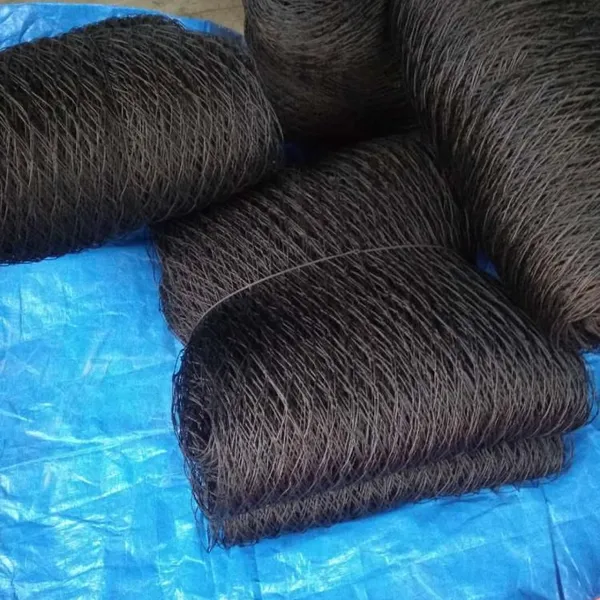 Read More
-
How the Black Oxide Layer Is Formed on Stainless Wire Rope
November 16, 2026Blackening a stainless rope is a surface chemistry problem wrapped in a mechanical one. The chemistry is a conversion of the alloy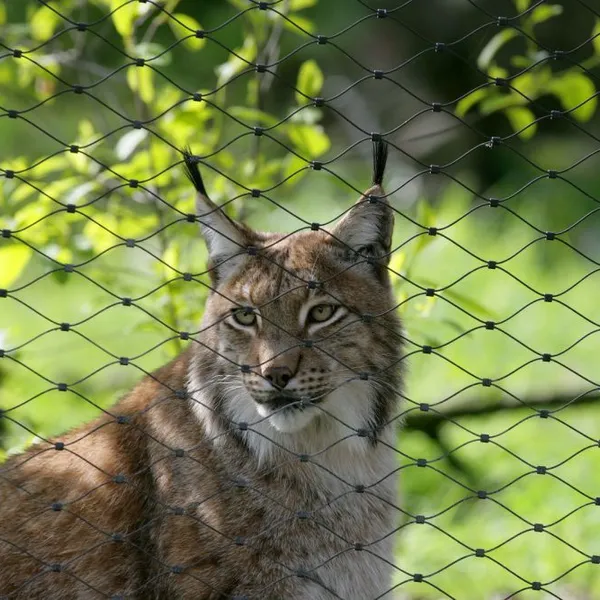 Read More
-
What Is Black Oxide Stainless Steel Wire Rope Mesh?
November 13, 2026A black oxide rope mesh is a stainless steel rope net whose wire has been chemically darkened before the mesh is assembled. The ro
Read More

Contact Us

Recommended Products
-
 Slope Protection System Rockfall Netting 2.0mm 3.0mm 4.0mm High Tensile Steel Wire Mesh Netting Rockfall BarriersUS$ 2 - 15MOQ: 1 Square Meter
-
Flexible Debris Flow Barrier Steel Rope Rockfall Barrier With Ring Diameter 350 mm China SupplierUS$ 5.9 - 40MOQ: 1 Square Meter
-
Custom Hexsteel Mesh for Refractory Linings Stainless Steel Wire Plain Weave Welded Cutting Welding Offered Made ChinaUS$ 9.20 - 45.00MOQ: 50 Square Meters
-
Double Twist Hexagonal Mesh Rockfall Netting Drapery System for for Rockfall Mitigation Slope Consolidation WorksUS$ 0.45MOQ: 100 Square Meters
-
China Factory Galvanized Steel Railway Side Slope Stabilization Net Woven Wire Mesh for Slope Protection Include Bending WeldingUS$ 15.00 - 20.00MOQ: 999 Square Meters
-
Galvanized Gabion Baskets for Retaining Wall Plain Weave Cutting Processing Service for Slope Stabilization-Free Sample OfferedUS$ 1.5 - 1.7MOQ: 1 Square Meter
-
Children's Playground Stainless Steel Rope Mesh Balcony Fence Inox Cable Net Build Guardrail Black Oxide Rope NettingUS$ 118.00MOQ: 100 Square Meters
-
Factory Direct Modern High Transparency Anti-Slip Stainless Steel Rope Mesh Stair Railing Woven Cable Netting Custom ProjectsUS$ 9.9 - 14.9MOQ: 1 Square Meter
-
Stainless Steel Rope Mesh for Backpack and Bag Anti Falling Dropring Mesh Inox Cable Net Anti-theft Black Oxide Rope NettingUS$ 118.00MOQ: 100 Square Meters
-
Heavy-Duty 4ftx5ft Drag Mat Factory With Chain Galvanized Steel Drag Mat for Tractor AttachmentUS$ 9.1 - 45MOQ: 1 Square Meter
-
High Altitude Anti Fall Woven Stainless Steel Wire Rope Net SS 304 316 316L Plain Weave Invisible Protective NetUS$ 9.9 - 14.9MOQ: 1 Square Meter
-
China Rope Mesh Manufacturer Customized SS316 Black Oxided Ferrule Type Rope MeshUS$ 5 - 20MOQ: 1 Square Meter
-
Baseball Field Dragging Lawn LevelingUS$ 59.00 - 66.00MOQ: 5 Pieces
-
316L Grade Stainless Steel Wire Mesh Sieves 200mm 300mm Screen Factory Price Sand Testing ScreenUS$ 4.7 - 15MOQ: 1 Piece
-
Outdoor Stainless Steel Cable Railing / Wire Rope Mesh / Wire Mesh Railings for BalconyUS$ 15.00 - 20.00MOQ: 100 Square Meters
-
Slope Protection System 65/3, High-tensile Steel Wire Mesh, Spike Plate, Rock Nail, Connection Clips T3 for Slope StabilityUS$ 1.80 - 3.00MOQ: 1 Square Meter
-
Pool Mesh Steeltex Paper-Backed Welded Wire Mesh Factory Price 12ga 16gaUS$ 40 - 70MOQ: 30 Rolls
-
G65 3 Rockfall Netting Rust Free Coated Slope Protection Net Galvanized High Tensile Wire Mesh Control Shallow LandslideUS$ 5.40 - 5.60MOQ: 1 Meter
-
Anti‑Drone Protection Steel Rope Net UAV Security Protection Fence Mesh Galvanized /Stainless Steel Customized ProductionUS$ 1.1 - 1.2MOQ: 100 Square Meters
-
Anti-Drone Netting, Galvanized High Tensile Steel Wire Rope Mesh, UVA Protection Net, CE Factory Customized ProductionUS$ 1.00 - 2.00MOQ: 999 Square Meters