Business License
Bridge Protection Mesh Fixing to Parapets and Cables
A parapet net fixing is usually drawn as a bracket and a bolt, and it is really a load path through four materials that were not designed to work together.
The mesh, the frame, the parapet and the anchor each behave differently under load, and the weakest of the four decides the strength of the whole assembly rather than the strongest.
This article covers what a parapet net fixing has to resist, the three supports a bridge net meets, cable stayed bridge mesh on a moving structure, the load path from mesh to anchor, anchor types and what each suits, fixing without drilling a coping stone, and two bridges where the fixing drove the panel.
1. What a Parapet Net Fixing Has To Resist
A parapet net fixing carries three loads, and just the first is in the direction the net appears to pull.
The first is tension, from the net being pulled tight and from a person leaning on it. The second is shear, from the weight of the panel and from anything that lands on it. The third is a moment, because the net is offset from the fixing face by the thickness of the bracket and that offset turns a tension into a bending moment at the anchor.
The moment is the load that pulls anchors out, and it is the one that a bracket detail can reduce. A shorter bracket reduces the offset and the moment together, which is why a flat plate detail is stronger than a deep arm of the same section.
A parapet net fixing also carries a fatigue load, because the net moves in the wind and the movement arrives at the anchor as a small reversing moment. That is a different design case from a static crowd load and it needs a different anchor.
2. The Three Supports a Bridge Net Meets
A bridge net anchor is fixed to one of three supports, and telling them apart is the first survey task.
| Support | Behaviour | Anchor route |
|---|---|---|
| Reinforced concrete parapet | Structural, takes a cast-in or a drilled anchor | Through-anchor with a back plate |
| Coping stone | Bedded, not anchored, takes almost nothing | None; fix through to the wall below |
| Steel post and rail | Structural but thin-walled | Clamp, or through-bolt with a sleeve |
The coping stone is the trap. It looks like the strongest part of the parapet, it is the easiest to drill, and it is held down by mortar rather than by a fixing. A net tied to it will lift the stones before it fails itself.
The second trap is a steel rail with a thin wall. A bolt tightened into a hollow section crushes the section and loses its grip, and the fixing looks tight until the first crowd leans on it.
A bridge net anchor into a hollow section therefore needs a sleeve or a through-bolt rather than a screw, and the sleeve has to be long enough to bear on both walls. The same rule applies to a thin concrete upstand, where the anchor needs to reach past the weak outer layer.
3. Cable Stayed Bridge Mesh and the Moving Structure
Cable stayed bridge mesh is fixed to a deck that moves, and the movement is continuous rather than occasional.
A stayed deck deflects under traffic and under temperature, and the parapet at the edge moves with it. A net fixed between two points on that deck will see the distance between them change by a few millimetres several times a day.
That is small in absolute terms and large in fatigue terms, because a few millimetres of movement at every vehicle pass is a stress cycle at every vehicle pass. A net tensioned rigidly between two such points will work its fixings loose within a season.
The detail that survives is one that allows the movement to happen at a known place. A slotted bracket, a shackle with clearance, or an intermediate fixing that carries the net without gripping it will all do that, and the choice is a drawing decision rather than a site one.
4. The Load Path From Mesh to Bridge Net Anchor
The load path runs from the wire, through a termination, into a bracket, through the anchor and into the structure, and each step can fail on its own.
The termination is the first step and the most common failure. A wire clamped in a bracket loses its coating and then its section, and the failure appears as a broken wire at the edge of the clamp rather than at the anchor.
The bracket is the second step. A bracket welded to a post is stronger than one bolted to it, and a bracket bolted to a post with two bolts is stronger than one with a single bolt in line with the load.
The anchor is the third step and the one with the least margin, because the structure it goes into was designed before anyone thought about a net. A bridge net anchor is also the step that is hardest to inspect once the panel is on, since the head is hidden behind a bracket and a plate.
5. Bridge Net Anchor Types and What Each Suits
Four anchor types are used on bridge parapets, and the choice follows from the support rather than from preference.
A cast-in socket is the soundest option and it needs to be designed in. It is used on new bridges where the net is part of the scheme from the start, and it removes the risk of drilling into reinforcement.
A through-anchor with a back plate is the usual retrofit. It passes through the parapet and bears on the far face, which turns a pull-out into a bearing problem and makes the capacity predictable.
A chemical anchor is used where a through-anchor is impossible, and it depends on the concrete being sound and dry. On a bridge deck the concrete at the parapet base is often neither, and a chemical anchor in damp concrete is a maintenance item rather than a fixing.
A clamp is used on steel and needs a shaped insert to match the profile. A clamp on a flat plate is reliable; a clamp on a circular section will rotate unless it is formed to the radius.
6. Parapet Net Fixing Without Drilling the Coping
Where the coping cannot be drilled, the parapet net fixing has to reach past it to something structural behind.
The usual route is a bracket that hooks over the coping and is anchored into the wall below, with the bracket shaped so that the load goes straight down the wall rather than through the stone. That detail is made to measure and it is worth making in one piece rather than in two bolted parts.
The alternative is a free-standing frame fixed to the deck, carrying the net independently of the parapet. It is more material and it needs a deck that can take the base moment, and it removes the risk of damaging a heritage parapet entirely.
Hebei Longen Wire Mesh Products supplies the bracket and the anchor as separate line items on any parapet net fixing, so that a client can see what is being fixed to what. Hebei Longen Wire Mesh Products Co Ltd will also decline to supply a bracket designed for a coping stone, because the failure that follows is not a net failure.
7. Cable Stayed Bridge Mesh at the Stay Collar
At the stay collar, cable stayed bridge mesh meets a component that cannot be touched.
A stay anchor is a highly stressed element with its own protection system, and no hole may be drilled into the collar, the guide or the anchorage. The net must pass the stay rather than attach to it, and that means a gap in the mesh closed by a split panel or a shaped infill.
The infill is made in two halves and clamped around the stay with a clearance that allows the stay to move. That clearance is a specification item, since a tight infill will rub the stay protection and a loose one will leave a gap a person can reach through.
Longen Wire Mesh Products makes stay infills to a measured collar diameter rather than to a nominal one, and Longen asks for a photograph of the collar with a tape against it on every first order for a stayed bridge.
8. Two Bridges Where the Fixing Drove the Panel
On a concrete parapet with a stone coping, the first panels were fixed through the coping as drawn. Two stones lifted within a season under wind movement, and the scheme was re-detailed with brackets anchored into the wall below. The panels were reused and the brackets were remade.
On a stayed bridge the first infills around the stays were made to a nominal diameter and were tight on three of the four stays. The tight ones rubbed the protection sleeve, and the infills were remade with a measured clearance and a rubber gasket at the contact face.
Hebei Longen Wire Mesh Products now asks for the support type before a fixing is quoted, and Longen will send a bracket sample for trial fitting on any parapet it has not seen before. A trial fit on one bay costs an hour and settles the detail for the whole bridge.
9. Frequently Asked Questions
9.1 Can a bridge net be fixed to a stone coping?
It can be fixed through it to the structure below, and it should not be fixed into it. A coping stone is bedded on mortar and held by its own weight, so an anchor in it is relying on the mortar rather than on the stone. A wind load applied at the top of a net will lift a coping before it pulls an anchor out, and the stone lands on whatever is below. The sound detail is a bracket that reaches past the coping and anchors into the wall, and it should be made in one piece.
9.2 Which anchor suits a concrete parapet?
A cast-in socket where the bridge is new, and a through-anchor with a back plate where it is not. Both make the capacity predictable, which matters more than the headline figure. A chemical anchor is acceptable where the concrete is sound and dry and where no through-hole is possible. An expansion anchor in a parapet is the least predictable of the four, because the edge distance is usually small and the concrete at an edge is the weakest part of the pour.
9.3 How much movement can a parapet net fixing allow?
Enough to cover the deck movement at that point over a temperature cycle, which on a long span can be several millimetres, plus the deflection under traffic. A slotted bracket with ten millimetres of travel in the direction of deck movement is a usual figure. The slot should be in the direction of movement and not in the direction of load, or the net will move when a person leans on it. Getting that orientation wrong is a common error.
9.4 How is a net fixed around a stay cable?
With a split infill panel clamped around the stay and a measured clearance to the collar, never with a fixing into the stay or its anchorage. The infill is made in two halves so that it can be installed without dismantling anything, and the two halves are joined with bolts that are accessible from the deck. The clearance is set to allow the stay to move under traffic and to leave no gap that a person could pass through, and it is worth measuring the collar rather than trusting a drawing.
9.5 Why do fixings fail before the mesh does?
Because the fixing is where the coating is cut during installation and where water collects afterwards. A net is exposed and dries, while a bracket holds water against a bolt head and a plate. The wire in the panel is also free to move a little, while the wire at the clamp cannot, so all the movement arrives at one point. A net inspected at its fixings will show the future failure a season before the panel does, which is why the fixings are the place to look first.
Recently Posted
-
Bridge Protection Mesh Aperture for Debris and Object Retention
November 6, 2026An aperture is a two-dimensional figure applied to three-dimensional objects, and that is why a net specified to catch bricks stil Read More
-
Bridge Protection Mesh: Wind Load and Fatigue Considerations
November 6, 2026A bridge net is a light element on a heavy structure, which is why its wind load is often dismissed and its fatigue is often misse Read More
-
Bridge Protection Mesh for Road and Rail Crossings
November 5, 2026A bridge over a live carriageway or a live railway is a structure where the thing below has priority, and every decision about the Read More
-
Bridge Protection Mesh for Pedestrian and Landscape Bridges
November 5, 2026A pedestrian bridge is a light structure carrying heavy behaviour, and its parapet is usually the lightest part of it. That combin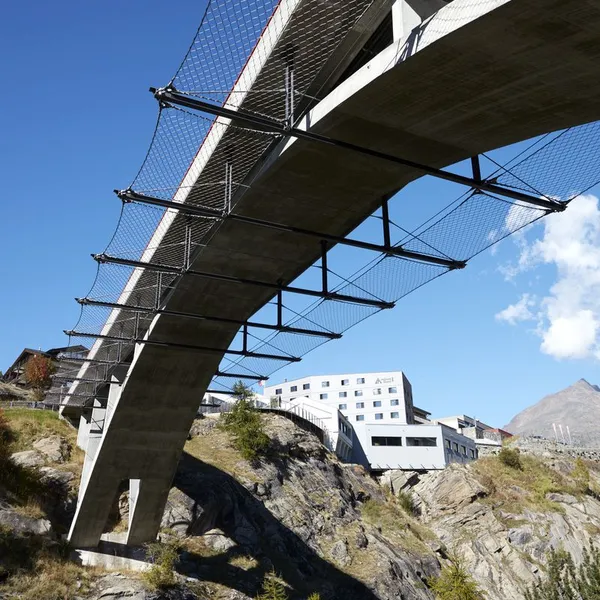 Read More

Contact Us

Recommended Products
-
 Slope Protection System Rockfall Netting 2.0mm 3.0mm 4.0mm High Tensile Steel Wire Mesh Netting Rockfall BarriersUS$ 2 - 15MOQ: 1 Square Meter
-
Flexible Debris Flow Barrier Steel Rope Rockfall Barrier With Ring Diameter 350 mm China SupplierUS$ 5.9 - 40MOQ: 1 Square Meter
-
Custom Hexsteel Mesh for Refractory Linings Stainless Steel Wire Plain Weave Welded Cutting Welding Offered Made ChinaUS$ 9.20 - 45.00MOQ: 50 Square Meters
-
Double Twist Hexagonal Mesh Rockfall Netting Drapery System for for Rockfall Mitigation Slope Consolidation WorksUS$ 0.45MOQ: 100 Square Meters
-
China Factory Galvanized Steel Railway Side Slope Stabilization Net Woven Wire Mesh for Slope Protection Include Bending WeldingUS$ 15.00 - 20.00MOQ: 999 Square Meters


-
Galvanized Gabion Baskets for Retaining Wall Plain Weave Cutting Processing Service for Slope Stabilization-Free Sample OfferedUS$ 1.5 - 1.7MOQ: 1 Square Meter
-
Children's Playground Stainless Steel Rope Mesh Balcony Fence Inox Cable Net Build Guardrail Black Oxide Rope NettingUS$ 118.00MOQ: 100 Square Meters
-
Factory Direct Modern High Transparency Anti-Slip Stainless Steel Rope Mesh Stair Railing Woven Cable Netting Custom ProjectsUS$ 9.9 - 14.9MOQ: 1 Square Meter
-
Stainless Steel Rope Mesh for Backpack and Bag Anti Falling Dropring Mesh Inox Cable Net Anti-theft Black Oxide Rope NettingUS$ 118.00MOQ: 100 Square Meters
-
Heavy-Duty 4ftx5ft Drag Mat Factory With Chain Galvanized Steel Drag Mat for Tractor AttachmentUS$ 9.1 - 45MOQ: 1 Square Meter


-
High Altitude Anti Fall Woven Stainless Steel Wire Rope Net SS 304 316 316L Plain Weave Invisible Protective NetUS$ 9.9 - 14.9MOQ: 1 Square Meter
-
China Rope Mesh Manufacturer Customized SS316 Black Oxided Ferrule Type Rope MeshUS$ 5 - 20MOQ: 1 Square Meter
-
Baseball Field Dragging Lawn LevelingUS$ 59.00 - 66.00MOQ: 5 Pieces
-
316L Grade Stainless Steel Wire Mesh Sieves 200mm 300mm Screen Factory Price Sand Testing ScreenUS$ 4.7 - 15MOQ: 1 Piece
-
Outdoor Stainless Steel Cable Railing / Wire Rope Mesh / Wire Mesh Railings for BalconyUS$ 15.00 - 20.00MOQ: 100 Square Meters


-
Slope Protection System 65/3, High-tensile Steel Wire Mesh, Spike Plate, Rock Nail, Connection Clips T3 for Slope StabilityUS$ 1.80 - 3.00MOQ: 1 Square Meter
-
Pool Mesh Steeltex Paper-Backed Welded Wire Mesh Factory Price 12ga 16gaUS$ 40 - 70MOQ: 30 Rolls
-
G65 3 Rockfall Netting Rust Free Coated Slope Protection Net Galvanized High Tensile Wire Mesh Control Shallow LandslideUS$ 5.40 - 5.60MOQ: 1 Meter
-
Anti‑Drone Protection Steel Rope Net UAV Security Protection Fence Mesh Galvanized /Stainless Steel Customized ProductionUS$ 1.1 - 1.2MOQ: 100 Square Meters
-
Anti-Drone Netting High Tensile Strength Stainless Steel Woven Wire Rope Mesh Active Rockfall Barrier Systemn Factory SupplyUS$ 15.00 - 20.00MOQ: 999 Square Meters