Business License
Drone Protection Netting Specifications: Mesh Size, Breaking Load and Coverage
A conference venue in the Middle East ordered drone netting across an open courtyard for a three day event. The supplier quoted 1,200 square metres at 150 mm aperture, which sounded generous until the site team worked out that the net covered the courtyard floor but left the two metre band above the perimeter wall open. The aircraft that appeared on the second evening came in over that band.
A drone netting mesh size specification has to answer three questions together: what the mesh must retain, what load the mesh and its supports must carry, and what area the barrier actually has to enclose. Miss any one of the three and the specification looks complete while leaving a route open.
This guide sets out the numbers behind each of those questions, the relationship between them, and the checks worth making before a panel schedule is released to the factory.
1. What a Drone Netting Mesh Size Specification Has to Fix
A drone netting mesh size specification fixes the aperture, the rope diameter, the panel size and the fixing detail. The aperture follows from the largest rotor span the site expects, and the rope follows from the impact energy that aperture has to carry.
Aperture is quoted between rope centres, as with architectural mesh, so a 100 mm aperture in 3 mm rope gives a clear opening near 97 mm. That distinction is rarely decisive on drone work, because the margin between a 300 mm rotor and a 100 mm hole is large.
The specification should also fix the method of joining panels. A 20 m span built from four panels has three seams, and each seam has to carry the same load as the panel beside it, which means a laced rod rather than a series of cable ties.
Corners deserve a heavier detail than the rest of the edge. The corner aperture of a large panel carries roughly twice the load of a mid edge aperture, so a pressed thimble or a doubled rope loop at each corner prevents the local distortion that shows up as a baggy panel after the first season.
2. Drone Net Breaking Strength: Rope, Joint and Panel
Drone net breaking strength is a panel property rather than a rope property. A 3 mm galvanised rope has a minimum breaking load near 7 kN, yet a panel laced at every crossing will fail at 60 to 75 percent of that figure if a joint slips first.
Test the panel, not the rope. A 1 m by 1 m sample pulled to destruction at the factory shows the real number, and it takes a day rather than a week, which is a small cost against a 1,000 square metre order.
Then apply a factor. Overhead barriers normally use 3.0 against the tested panel value, rising to 4.0 where the net hangs above a working area with people beneath it, because a captured aircraft that drops still delivers energy to whatever is below.
The test report should name the panel size, the rope construction, the joint type and the direction of the pull. Without those four lines the number cannot be compared with another supplier figure, and a buyer ends up choosing between two values that describe different tests. Longen marks that detail on the panel schedule rather than on a marketing sheet.
3. Anti Drone Net Coverage Area and the Drape Factor
Anti drone net coverage area is measured on the net, not on the ground. A net pitched at 10 degrees over a 30 m by 40 m roof needs about 8 percent more material than the plan area, and a net draped between two buildings can need 20 percent more.
The drape factor is the ratio between the finished net surface and the flat plan area. Values run from 1.05 for a gently pitched panel to 1.25 for a draped installation with a low point for recovery, and quoting without it is the most common cause of a short delivery.
Overlap belongs in the same calculation. A 10 percent overlap on every side adds roughly 20 percent to the perimeter length, which on a 30 m by 40 m roof is another 28 m of net edge to supply and fix.
4. A Drone Netting Mesh Size Specification Table by Aircraft Class
The table below sets aperture and rope against the aircraft class a site is most likely to see. Aircraft mass is the planning figure, and the impact energy column assumes a closing speed of 15 m per second.
| Aircraft mass | Aperture | Rope diameter | Impact energy | Panel size guide |
|---|---|---|---|---|
| Under 1 kg | 100–120 mm | 2.0 mm | about 110 J | 10 x 10 m |
| 1–2 kg | 80–100 mm | 2.5 mm | 110–225 J | 10 x 10 m |
| 2–5 kg | 60–80 mm | 3.0 mm | 225–560 J | 8 x 8 m |
| 5–10 kg | 60 mm | 4.0 mm | 560–1,125 J | 6 x 6 m |
Panel size shrinks as the aircraft class rises, because a heavier impact deflects a larger area and a smaller panel distributes that deflection to more supports. Treat the sizes as a starting point and confirm them against the support layout.
Panel size and support spacing move together. Four 5 m panels across a 20 m span need three intermediate supports, while two 10 m panels need one, and the second arrangement is cheaper to build even though the panels cost slightly more per square metre.
5. Drone Net Breaking Strength in Support and Anchor Design
Support design starts from the panel reaction rather than from the rope rating, because drone net breaking strength describes the mesh while the support sees the mesh plus the impact. A 10 m by 10 m panel at 3.0 mm rope with a 3.0 factor delivers roughly 2.3 kN per corner under wind alone, before any impact is considered.
Impact changes the shape of that load. A 3 kg aircraft arriving at 15 m per second produces a short duration force of 6 kN to 9 kN at the point of contact, which the mesh spreads across several ropes and then into the perimeter cable.
Anchors therefore need a pull test rather than a calculation from a catalogue. A chemical anchor into a concrete parapet at 600 mm centres is the usual arrangement, and the test record for three anchors per elevation is worth more than a page of theory.
Uplift is the case that catches fabricators out. Wind passing over a net can produce an upward force on the perimeter cable as well as a downward one, and an anchor designed for tension alone may not resist the reversal. Specify the fixing for both directions and check it against the parapet detail rather than the roof slab.
6. Anti Drone Net Coverage Area, Sag and Support Spacing
Sag governs the support spacing on large anti drone net coverage area. A net left unsupported across 30 m will sag 600 mm to 900 mm under its own weight, and the sag grows in wind until the panel starts to flap against the structure.
A sensible rule is one support line every 8 m to 12 m for stainless rope mesh, or every 6 m for a heavier galvanized panel. Below 8 m the structure cost climbs faster than the net cost falls, and above 12 m the net begins to look slack even when it is correctly tensioned.
Cable trusses are the usual answer above 20 m spans. A truss of two 12 mm cables with vertical droppers carries the net across a span where a steel beam would be impractical, and it costs roughly 40 percent of the equivalent beam structure.
Foundations follow the reaction. A pole carrying 12 m of net at 3 m above the roof takes an overturning moment of roughly 45 kNm at the base, which needs a pad of 1.5 m by 1.5 m by 0.6 m in ordinary ground. On a roof, that load has to go into a beam rather than into a pad. Longen checks those reactions against the structural drawings before releasing a frame package.
7. Wind Load on a Large Anti Drone Net Coverage Area
Wind is the governing load on most installations, and a net is not a solid surface. A mesh at 5 percent open area still catches air, and the drag coefficient for a woven net typically falls between 0.6 and 1.0 depending on the aperture ratio.
Height raises the figure. A net 12 m above a roof sits in a wind speed roughly 15 percent higher than the roof edge, and that difference enters the calculation squared, so the pressure rises by about a third.
Local topography decides the rest. A site on a coastal headland sees far more than the same net inland, and the design should use the exposure category that matches the site rather than the default in the code.
Water and debris add a secondary load that codes rarely cover. A net that collects leaf litter in autumn gains weight unevenly, and a ponded area after heavy rain can double the local load on a few panels. A 10 degree pitch and an open aperture solve most of that without extra steel.
8. Checking a Drone Netting Mesh Size Specification Before Ordering
Read the specification against the site rather than against the previous project. Confirm that the aperture suits the largest aircraft expected, that the drape factor is stated, and that the panel schedule adds up to the covered surface rather than to the plan area.
Then check the documents. The panel test record, the rope certificate and the galvanizing weight should all be named in the order, because a galvanized net without a coating figure is a net of unknown life.
Hebei Longen Wire Mesh Products Co Ltd issues a specification sheet that lists the mesh size, the tested panel strength, the drape factor and the assumed aircraft class on one page. Longen Wire Mesh Products also states the wind speed used for the support design, which is the number most quotations leave out and the one that decides whether the structure stands.
9. Frequently Asked Questions
9.1 How is drone net breaking strength tested on a finished panel?
A sample panel of at least 1 m by 1 m is clamped on four edges and pulled until a rope or a joint fails, with the peak load recorded. The result is typically 60 to 75 percent of the single rope figure, because the joints and the load sharing between ropes govern the outcome. Ask for the test method as well as the number, since a panel tested on two edges reports a figure that cannot be compared with a four edge result.
9.2 What safety factor should a drone net breaking strength figure carry?
Use 3.0 against the tested panel value for an overhead barrier over a yard or a plant area, and 4.0 where people work beneath the net. The factor covers rope variability, installation tolerance, corrosion loss over the design life and the uncertainty in the impact load itself. Where the site is coastal, add a corrosion allowance rather than raising the factor, because the two deal with different risks and stacking them makes the structure unnecessarily heavy for the load it actually sees.
9.3 How do I calculate anti drone net coverage area for a pitched roof?
Multiply the plan area by the drape factor that matches the geometry, which is 1.05 to 1.08 for a gentle pitch and up to 1.20 for a steep one, then add the overlap on every edge. A 30 m by 40 m roof at 1.08 gives 1,296 square metres before overlap, and a 10 percent overlap on each side brings the net to roughly 1,400 square metres. Quote the figure as net area rather than plan area, so the factory and the site are measuring the same surface before anyone places an order.
9.4 Does a drone netting mesh size specification change for coastal sites?
It changes in material rather than in geometry. A coastal site should move from galvanized to type 316 stainless rope, because the zinc coating on a galvanized net is consumed faster in salt air and the net above a roof is difficult to replace. The aperture and the rope diameter stay as they were. Ask for the rope certificate with the molybdenum figure stated, and plan a fresh water wash once a year for the lower panels, where road spray and sea mist collect first.
Recently Posted
-
Zoo and Aviary Enclosures in Stainless Steel Cable Net: Design Notes
October 23, 2026A bird park in Northern Europe rebuilt its walk-through aviary with a stainless net at 60 mm aperture, chosen because the mesh loo Read More
-
Stainless Steel Wire Rope Net for Balcony and Staircase Fall Protection
October 23, 2026A residential refurbishment in a European city replaced 46 balconies of solid panel infill with glazed balustrades, and the client Read More
-
Stainless Steel Wire Rope Net Mesh Opening and Wire Diameter Sizing
October 22, 2026An atrium net in a northern office building was specified at 80 mm aperture in 1.5 mm rope, chosen because the sample looked light Read More
-
Sourcing Drone Protection Netting: A Buyer Checklist for Custom Projects
October 22, 2026A logistics operator in the Middle East ordered drone protection netting for two warehouse roofs on the strength of a single photo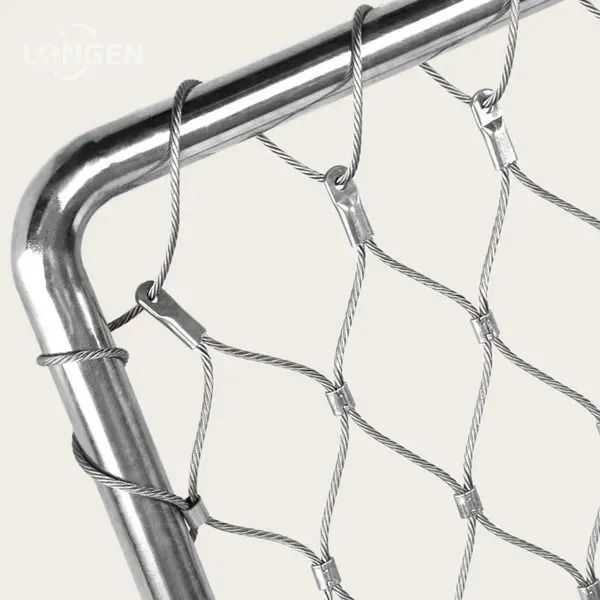 Read More

Contact Us

Recommended Products
-
 Slope Protection System Rockfall Netting 2.0mm 3.0mm 4.0mm High Tensile Steel Wire Mesh Netting Rockfall BarriersUS$ 2 - 15MOQ: 1 Square Meter
-
Flexible Debris Flow Barrier Steel Rope Rockfall Barrier With Ring Diameter 350 mm China SupplierUS$ 5.9 - 40MOQ: 1 Square Meter
-
Custom Hexsteel Mesh for Refractory Linings Stainless Steel Wire Plain Weave Welded Cutting Welding Offered Made ChinaUS$ 9.20 - 45.00MOQ: 50 Square Meters
-
Double Twist Hexagonal Mesh Rockfall Netting Drapery System for for Rockfall Mitigation Slope Consolidation WorksUS$ 0.45MOQ: 100 Square Meters
-
China Factory Galvanized Steel Railway Side Slope Stabilization Net Woven Wire Mesh for Slope Protection Include Bending WeldingUS$ 15.00 - 20.00MOQ: 999 Square Meters


-
Galvanized Gabion Baskets for Retaining Wall Plain Weave Cutting Processing Service for Slope Stabilization-Free Sample OfferedUS$ 1.5 - 1.7MOQ: 1 Square Meter
-
Children's Playground Stainless Steel Rope Mesh Balcony Fence Inox Cable Net Build Guardrail Black Oxide Rope NettingUS$ 118.00MOQ: 100 Square Meters
-
Factory Direct Modern High Transparency Anti-Slip Stainless Steel Rope Mesh Stair Railing Woven Cable Netting Custom ProjectsUS$ 9.9 - 14.9MOQ: 1 Square Meter
-
Stainless Steel Rope Mesh for Backpack and Bag Anti Falling Dropring Mesh Inox Cable Net Anti-theft Black Oxide Rope NettingUS$ 118.00MOQ: 100 Square Meters
-
Heavy-Duty 4ftx5ft Drag Mat Factory With Chain Galvanized Steel Drag Mat for Tractor AttachmentUS$ 9.1 - 45MOQ: 1 Square Meter


-
High Altitude Anti Fall Woven Stainless Steel Wire Rope Net SS 304 316 316L Plain Weave Invisible Protective NetUS$ 9.9 - 14.9MOQ: 1 Square Meter
-
China Rope Mesh Manufacturer Customized SS316 Black Oxided Ferrule Type Rope MeshUS$ 5 - 20MOQ: 1 Square Meter
-
Baseball Field Dragging Lawn LevelingUS$ 59.00 - 66.00MOQ: 5 Pieces
-
316L Grade Stainless Steel Wire Mesh Sieves 200mm 300mm Screen Factory Price Sand Testing ScreenUS$ 4.7 - 15MOQ: 1 Piece
-
Outdoor Stainless Steel Cable Railing / Wire Rope Mesh / Wire Mesh Railings for BalconyUS$ 15.00 - 20.00MOQ: 100 Square Meters


-
Slope Protection System 65/3, High-tensile Steel Wire Mesh, Spike Plate, Rock Nail, Connection Clips T3 for Slope StabilityUS$ 1.80 - 3.00MOQ: 1 Square Meter
-
Pool Mesh Steeltex Paper-Backed Welded Wire Mesh Factory Price 12ga 16gaUS$ 40 - 70MOQ: 30 Rolls
-
G65 3 Rockfall Netting Rust Free Coated Slope Protection Net Galvanized High Tensile Wire Mesh Control Shallow LandslideUS$ 5.40 - 5.60MOQ: 1 Meter
-
Anti‑Drone Protection Steel Rope Net UAV Security Protection Fence Mesh Galvanized /Stainless Steel Customized ProductionUS$ 1.1 - 1.2MOQ: 100 Square Meters
-
Anti-Drone Netting High Tensile Strength Stainless Steel Woven Wire Rope Mesh Active Rockfall Barrier Systemn Factory SupplyUS$ 15.00 - 20.00MOQ: 999 Square Meters