
 Business License
What Is a Stainless Steel Wire Rope Net? Construction, Mesh Types and Load Paths
A coastal hotel refurbishment ordered a decorative stainless net with 60 mm apertures and 1.5 mm rope for a six storey atrium. The panels matched the drawing and went up in a week. One heating season later the corner bays had slackened by roughly 40 mm, two ferrule groups showed rust bleeding, and the contractor had to re-tension every panel from rented scaffolding.
That sequence is common, and it rarely traces back to the steel. A rope net is a structure rather than a fabric, so the rope diameter, the crossing type, the edge frame and the tensioning detail all decide how the panel behaves under wind, thermal movement and a leaning body.
This guide covers the anatomy of a panel, the three mesh patterns in commercial use, the load paths a flexible steel cable net develops, and the checks that decide whether a handover goes smoothly.
1. How Wire Rope Net Construction Comes Together
Every panel is three systems working together. The first is the rope grid, a set of parallel strands running in two directions. The second is the connection at each crossing, which is where the grid becomes a surface. The third is the perimeter, where the grid hands its load to a frame, a tensioned cable or the building itself.
The rope itself is stranded stainless, usually 7x7 or 7x19 construction. A 7x7 rope of 2 mm diameter has a minimum breaking load around 3.2 kN, while a 7x19 rope of the same diameter is more flexible but loses roughly 10 percent of that figure. Diameters between 1.2 mm and 4.0 mm cover most architectural work.
Panel size is a design decision, not a shipping accident. Widths of 2.0 m to 3.0 m and heights of 2.5 m to 4.0 m keep handling manageable on site, and a two person crew can lift and place a 3 m by 3 m panel of 2 mm rope without mechanical help.
2. Rope Net Mesh Pattern and What It Changes
The rope net mesh pattern is the geometry a buyer sees first, and it governs nearly everything else. Diamonds open the surface visually and suit curved frames. Squares read as a grid and align neatly with rectangular openings. Hexagons sit between the two and appear in larger facade work.
Aperture is normally quoted between rope centres, so the clear opening is smaller than the nominal figure by one rope diameter. A 60 mm aperture in 2 mm rope gives a clear opening near 58 mm, which matters when the net has to resist a 100 mm sphere or a small animal.
Transparency follows from the ratio between aperture and rope diameter, not from the aperture alone. An 80 mm aperture in 2 mm rope blocks roughly 5 percent of the sight line, so the surface almost disappears at 10 m. Halving the aperture to 40 mm raises that figure to about 10 percent and makes the net read as a screen.
3. Where a Flexible Steel Cable Net Carries Load
A flexible steel cable net transfers load along the ropes, not across the surface. A body or a wind gust pushes one area, the strands straighten, and the force travels to the nearest edge rope and then to the anchors. This is why perimeter fixing carries more importance than panel thickness.
Wind is usually the governing case outdoors. At a basic velocity pressure of 0.6 kN per square metre, a 3 m by 3 m panel collects roughly 5.4 kN, and a safety factor of 2.5 pushes the design anchor load past 13 kN. Internal partitions see far less, typically under 1 kN.
A person leaning or falling against the net adds a point load of 0.5 kN to 1.0 kN depending on the standard applied. That figure looks small beside the wind case, yet it acts on a single aperture and tests the ferrule rather than the anchor.
This is why a wire rope net construction drawing should show the anchor detail as clearly as the aperture. Where the substrate is brick or block, fixing a flexible steel cable net with a chemical anchor at 600 mm to 900 mm centres carries the perimeter load far better than a mechanical fixing into a 40 mm render skin.
4. Ferrules, Sleeves and Edge Frames in Wire Rope Net Construction
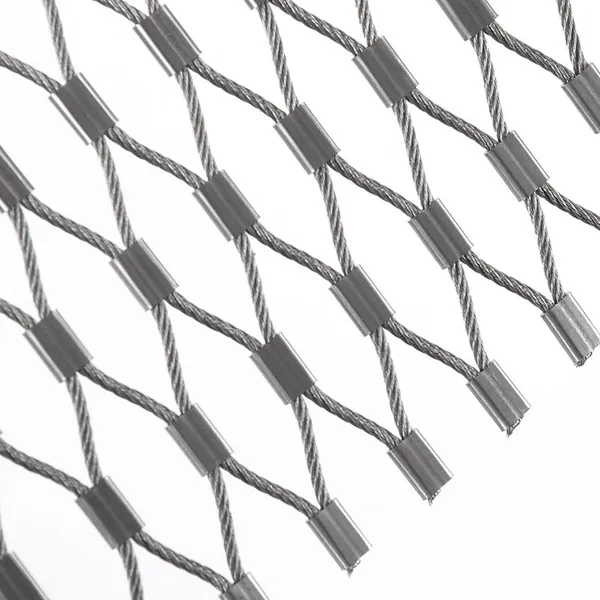
At each crossing, a ferrule or sleeve clamps the two ropes together. The ferrule is pressed with a hydraulic tool at roughly 60 to 80 tonnes, and the press leaves a witness mark that inspectors use to confirm every crossing was closed. A panel of 3 m by 3 m at 60 mm aperture carries about 2,500 crossings.
Longen Wire Mesh Products presses ferrules in a jig that holds the aperture to within 1 mm across a full panel, which keeps the grid square when the panels are joined on site. The same jig accommodates square, diamond and hexagonal layouts without changing the rope path.
The edge frame is the stiffest element in the assembly. An 8 mm stainless rod welded or swaged to the perimeter holds the pattern, gives the tensioning hardware something to grip, and stops the outer apertures from distorting under load.
Knotted panels are built by a different route. The operator ties each crossing by hand, then sets the knot in a press, which suits unusual geometries and small quantities but takes roughly three times the labour per square metre.
5. Matching Rope Net Mesh Pattern to the Opening
A balcony infill usually wants a 40 mm to 60 mm aperture in 2 mm rope, because the net must resist a child and still let air and light through. A stair void accepts 60 mm to 80 mm, since the net sits behind a handrail that already controls access. Facade screens run larger, often 100 mm to 200 mm, where the net is a visual filter rather than a barrier.
Grade selection follows the exposure. Type 304 suits inland and indoor work, while 316 or 316L is the sensible default within 5 km of salt water or in a chlorinated pool hall. The cost difference is modest against the cost of re-stringing a panel in place.
On a curved frame the rope net mesh pattern has to follow the geometry, so drawings are flattened into developable strips before cutting. Each strip then carries its own aperture count, and the joints between strips become part of the pattern rather than a break in it.
Tensioning deserves the same attention as the pattern. Turnbuckles at 1.5 m to 2.5 m centres let the installer take up slack after the first thermal cycle, and a 5 mm to 10 mm deflection under hand pressure is a practical field test for a correctly tensioned panel.
6. Wire Rope Net Construction Options Compared in a Table
The three patterns differ in cost, lead time and how they fail, and the table below sets the usual ranges side by side. Figures are indicative for type 304 and 316 rope in the middle of the architectural range.
| Pattern | Typical aperture | Rope diameter | Relative cost | Usual use |
|---|---|---|---|---|
| Ferruled diamond | 40–120 mm | 1.5–3.0 mm | Baseline | Balcony infill, stair voids, atrium screens |
| Ferruled square | 50–150 mm | 2.0–4.0 mm | Baseline plus 5 percent | Facade grids, partition screens |
| Knotted | 60–200 mm | 2.0–4.0 mm | Baseline plus 30 percent | Zoo enclosures, heritage retrofit |
| Woven or interwoven | 30–80 mm | 1.2–2.0 mm | Baseline plus 20 percent | Fine decorative screens, curved shells |
Cost differences of that size rarely decide a project on their own. What decides it is the frame the building already has, because a rigid rectangular opening takes a square grid far more cheaply than a curved one.
7. When a Flexible Steel Cable Net Is the Wrong Choice
The net is a barrier and a screen, not a security fence. A 2 mm rope at 60 mm aperture can be cut with a good bolt cutter in under a minute, so applications that need delay time should look at welded mesh or a layered system instead.
Privacy is another limit. Even a 30 mm aperture leaves more than 80 percent of the surface open, so a rope net will not screen a bedroom window in the way a fabric or a solid panel does. Longen advises clients to mock up a sample against a lit window before committing to a large order.
Hebei Longen Wire Mesh Products Co Ltd keeps a sample board of each pattern in the sales office for this purpose. A buyer can hold a 300 mm square against a window, photograph it from 5 m, and judge the real density of each rope net mesh pattern before a purchase order is raised.
Extreme debris exposure is the third case. Where a site faces regular wind borne gravel or ice, the lower panels take repeated impact and the rope can develop local kinks that shorten service life. A heavier rope in a smaller aperture helps, but a different product may suit the duty better.
8. Inspection and Handover on Wire Rope Net Construction
Handover should start with the ferrule marks. Every crossing carries a press mark, and a missing mark means the sleeve was never closed. A 10 percent visual sample per panel is normally enough to catch a systematic fault.
Aperture measurement comes next, taken at three points per panel with a steel rule. A tolerance of plus or minus 2 mm across a 60 mm aperture is realistic for a pressed panel, and anything looser points to worn tooling.
Documents complete the picture: the mill certificate for the rope, the grade marking on the ferrules, and the anchor pull test record where the project calls for one. Stainless rope does not carry a coating to measure, so the alloy certificate replaces the coating thickness report used on galvanized work.
A panel schedule should travel with the shipment. Longen lists the wire rope net construction of every piece on that schedule, including rope grade, aperture, panel size and the frame type the panel was built for, so the site team can match each panel to its opening without opening crates.
9. Frequently Asked Questions
9.1 What is the difference between a rope net and a cable net?
The two names describe the same family of product, and the difference is one of scale. A cable net usually refers to structural strands of 8 mm and above carrying heavy loads in slope or barrier work. A rope net refers to the finer architectural grades between 1.2 mm and 4.0 mm, where the surface is a screen, an infill or a fall protection layer rather than a primary structural member. Buyers who ask for a flexible steel cable net in a building context almost always need the finer product.
9.2 Does the rope net mesh pattern change the load rating of a panel?
It changes how the load reaches the edge, and that is the figure a designer needs. A diamond pattern sheds load along two diagonal directions and suits a frame with corner anchors, while a square pattern lines up with rectangular frames and gives a more predictable deflection under wind. Pattern affects stiffness by roughly 10 to 15 percent at the same rope and aperture, whereas rope diameter changes it far more sharply. Specify rope and aperture first, then choose the pattern that suits the frame.
9.3 How is a flexible steel cable net tensioned after installation?
Tensioning happens at the perimeter, never by pulling on the grid itself. The panel is fixed on three sides, a turnbuckle or threaded rod is fitted on the fourth, and the assembly is drawn up until the surface reads flat from a distance of 3 m. A deflection of 5 mm to 10 mm under hand pressure is the field check most installers use. Re-check after the first hot and cold cycle, because stainless rope settles by a few millimetres in the first month.
9.4 How long does a stainless rope net last outdoors?
Service life depends on grade and atmosphere rather than on the pattern. Type 316 rope in a coastal setting typically shows no structural loss after 15 years of exposure, and inland installations commonly run well past 20 years. Type 304 in the same coastal air can show tea staining within two to three years, which is cosmetic but hard to reverse once it starts. Rope net installations with a proper grade choice and a wash down twice a year reach the upper end of those ranges.
Recently Posted
-
SS 304 vs 316 vs 316L in Stainless Steel Wire Rope Net: A Corrosion Comparison
October 21, 2026A resort on a Mediterranean island replaced its balcony infill with type 304 rope net to hold the budget, and the specification lo Read More
-
What Is Drone Protection Netting? How a Physical Airspace Barrier Works
October 20, 2026A data hall operator in Southeast Asia installed a camera and sensor package across two rooftops after a series of unauthorised dr Read More
-
Stainless Steel Rope Mesh Patterns Compared: Ferruled, Knotted and Woven Panels
October 20, 2026An aviary project in a northern zoo ordered three identical panels from three suppliers. One came ferruled, one knotted and one wo Read More
-
Application of stainless steel hexmesh (hexmetal)
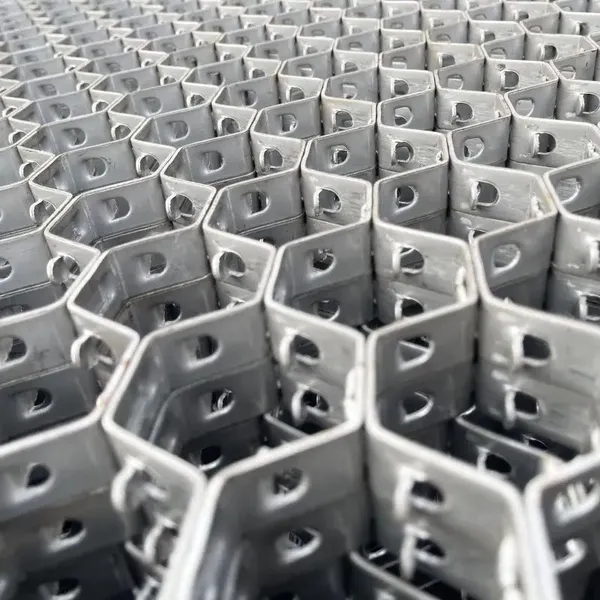
April 26, 2026The stainless steel hexmesh(hexmetal)produced by Longen is mainly used in industrial lining reinforcement scenarios that require r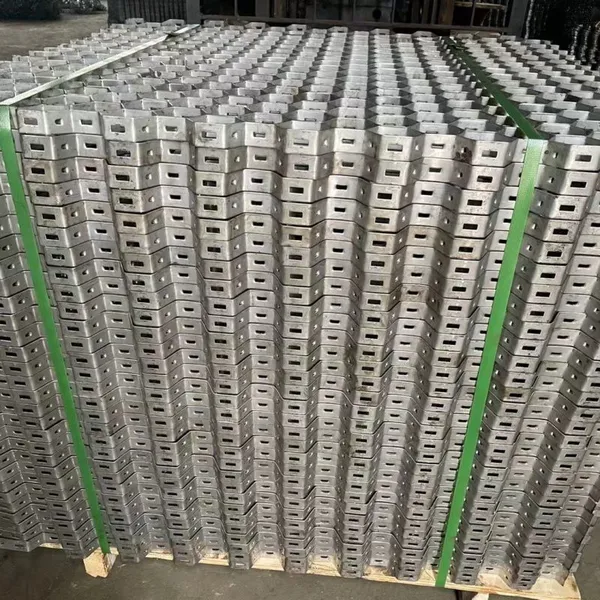 Read More

Contact Us

Recommended Products
-
 Slope Protection System Rockfall Netting 2.0mm 3.0mm 4.0mm High Tensile Steel Wire Mesh Netting Rockfall BarriersUS$ 2 - 15MOQ: 1 Square Meter
-
Flexible Debris Flow Barrier Steel Rope Rockfall Barrier With Ring Diameter 350 mm China SupplierUS$ 5.9 - 40MOQ: 1 Square Meter
-
Custom Hexsteel Mesh for Refractory Linings Stainless Steel Wire Plain Weave Welded Cutting Welding Offered Made ChinaUS$ 9.20 - 45.00MOQ: 50 Square Meters
-
Double Twist Hexagonal Mesh Rockfall Netting Drapery System for for Rockfall Mitigation Slope Consolidation WorksUS$ 0.45MOQ: 100 Square Meters
-
China Factory Galvanized Steel Railway Side Slope Stabilization Net Woven Wire Mesh for Slope Protection Include Bending WeldingUS$ 15.00 - 20.00MOQ: 999 Square Meters
-
Galvanized Gabion Baskets for Retaining Wall Plain Weave Cutting Processing Service for Slope Stabilization-Free Sample OfferedUS$ 1.5 - 1.7MOQ: 1 Square Meter
-
Children's Playground Stainless Steel Rope Mesh Balcony Fence Inox Cable Net Build Guardrail Black Oxide Rope NettingUS$ 118.00MOQ: 100 Square Meters
-
Factory Direct Modern High Transparency Anti-Slip Stainless Steel Rope Mesh Stair Railing Woven Cable Netting Custom ProjectsUS$ 9.9 - 14.9MOQ: 1 Square Meter
-
Stainless Steel Rope Mesh for Backpack and Bag Anti Falling Dropring Mesh Inox Cable Net Anti-theft Black Oxide Rope NettingUS$ 118.00MOQ: 100 Square Meters
-
Heavy-Duty 4ftx5ft Drag Mat Factory With Chain Galvanized Steel Drag Mat for Tractor AttachmentUS$ 9.1 - 45MOQ: 1 Square Meter
-
High Altitude Anti Fall Woven Stainless Steel Wire Rope Net SS 304 316 316L Plain Weave Invisible Protective NetUS$ 9.9 - 14.9MOQ: 1 Square Meter
-
China Rope Mesh Manufacturer Customized SS316 Black Oxided Ferrule Type Rope MeshUS$ 5 - 20MOQ: 1 Square Meter
-
Baseball Field Dragging Lawn LevelingUS$ 59.00 - 66.00MOQ: 5 Pieces
-
316L Grade Stainless Steel Wire Mesh Sieves 200mm 300mm Screen Factory Price Sand Testing ScreenUS$ 4.7 - 15MOQ: 1 Piece
-
Outdoor Stainless Steel Cable Railing / Wire Rope Mesh / Wire Mesh Railings for BalconyUS$ 15.00 - 20.00MOQ: 100 Square Meters
-
Slope Protection System 65/3, High-tensile Steel Wire Mesh, Spike Plate, Rock Nail, Connection Clips T3 for Slope StabilityUS$ 1.80 - 3.00MOQ: 1 Square Meter
-
Pool Mesh Steeltex Paper-Backed Welded Wire Mesh Factory Price 12ga 16gaUS$ 40 - 70MOQ: 30 Rolls
-
G65 3 Rockfall Netting Rust Free Coated Slope Protection Net Galvanized High Tensile Wire Mesh Control Shallow LandslideUS$ 5.40 - 5.60MOQ: 1 Meter
-
Anti‑Drone Protection Steel Rope Net UAV Security Protection Fence Mesh Galvanized /Stainless Steel Customized ProductionUS$ 1.1 - 1.2MOQ: 100 Square Meters
-
Anti-Drone Netting High Tensile Strength Stainless Steel Woven Wire Rope Mesh Active Rockfall Barrier Systemn Factory SupplyUS$ 15.00 - 20.00MOQ: 999 Square Meters